Overlapping Circles Area Calculator
Input the radii and the distance to find the overlap. Killer Feature: Input the desired Intersection Area, and our numerical solver will instantly reverse-engineer the exact Distance between centers needed!
Intersection Area Conversions
Engineering Metrics
Overlapping circles occur when two circles intersect partially or completely, creating a shared region between them. This shared region is called the intersection area or overlap area. The size of the overlap depends on: the radius of each circle, and the distance between their centers.
An overlapping circles area calculator helps determine the exact area of this intersecting region automatically. Because overlap geometry involves curved segments and nonlinear relationships, manual calculations can quickly become complicated, especially when the circles have different radii.
The calculator can also determine: total union area, non-overlapping regions, and center-distance relationships.
Some advanced calculators even support reverse solving, allowing users to calculate the exact center distance required to achieve a desired overlap area.
These calculations appear frequently in engineering, wireless coverage systems, GIS mapping, collision detection, sensor networks, architecture, astronomy, and industrial design where circular regions interact dynamically.
How Circle Intersection Geometry Works
When two circles move closer together, the overlap area gradually increases. As the center distance decreases: the shared region becomes larger, curved intersection boundaries form, and the geometry changes continuously.
- If the circles touch at exactly one point, they are called tangent circles. If the circles move farther apart than the sum of their radii, the overlap disappears completely.
In cases where one circle lies entirely inside another, full containment occurs. This changes the overlap behavior significantly because the smaller circle becomes completely enclosed.
Unlike simple polygon intersections, overlapping circles involve curved geometry, which is why the formulas become more advanced.
Difference Between Intersection and Union Area
The intersection area represents only the shared overlapping region between the circles.
The union area represents the total combined area covered by both circles after subtracting the overlap once to avoid double counting.
This distinction is important in practical applications such as: wireless signal coverage, radar systems, mapping software, and Venn diagram analysis.
What the Overlapping Circles Area Calculator Solves
An overlapping circles area calculator simplifies complex circular intersection calculations by automatically solving the geometry from a few known measurements.
Most users enter: the radius of each circle, and the distance between their centers.
The calculator then determines: overlap/intersection area, total union area, individual circle areas, and unit conversions.
Some calculators also support reverse engineering. Instead of entering the distance directly, users can specify a desired overlap area, and the calculator estimates the center distance required to produce that exact intersection.
This feature becomes especially valuable in engineering optimization problems involving: wireless network coverage, sensor placement, collision analysis, industrial spacing systems, and circular packing layouts.
Because overlap geometry changes nonlinearly, even small distance adjustments can dramatically affect the shared area. A calculator simplifies these calculations while reducing manual errors.
Overlapping Circle Formulas
Several formulas work together when calculating overlapping circle geometry.
Circle Area Formula
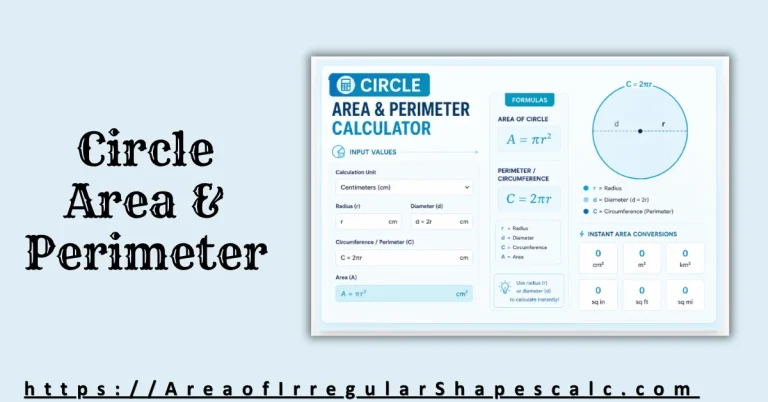
The area of a circle is calculated using:
\(A=\pi r^2\)
Where:
-
A= circle area -
r= radius -
\pi= pi
This formula calculates the total area of each individual circle before overlap calculations begin.
Union Area Formula
The total union area of two overlapping circles is calculated using:
\(A_{union}=A_1+A_2-A_{intersection}\)
Where:
-
A_1= area of circle 1 -
A_2= area of circle 2 -
A_{intersection}= overlap area
The overlap must be subtracted once because it is included in both circle areas initially.
Overlap Area Formula
The overlap area formula is significantly more complex because it combines: circular sectors, curved segments, and geometric intersection relationships.
For two circles with radii r₁ and r₂ separated by center distance d, the overlap area involves inverse cosine calculations and square root geometry terms.
Because the equation is lengthy and difficult to solve manually, calculators are commonly used instead of hand calculations.
This is especially true in engineering systems where precise overlap measurements are required repeatedly.
Why Overlap Calculations Become Complex
Circle intersections create curved boundaries instead of straight-line edges.
As the circles move: overlap changes continuously, segment shapes deform dynamically, and the geometry behaves nonlinearly.
Unlike rectangles or polygons, circle overlap cannot usually be simplified into basic area subtraction.
This complexity explains why specialized calculators are commonly used in engineering and geometry software.
How to Use the Overlapping Circles Area Calculator
The calculator is designed to simplify overlap geometry while still helping users understand the relationships between the measurements.
Start by entering:
-
the radius of circle 1,
-
the radius of circle 2,
-
and the distance between the centers.
After selecting the measurement unit, run the calculation.
The calculator automatically determines: overlap area, total union area, individual circle areas, and area conversions.
If reverse-solving is supported, users can also enter a desired overlap area instead of distance. The calculator then estimates the required center spacing automatically.
This feature is particularly useful in applications involving optimized signal coverage, sensor placement, or controlled overlap systems.
Understanding Circle Intersection Geometry
Circle overlap geometry changes dramatically depending on the center distance.
No Overlap vs Partial Overlap vs Full Containment
When the distance between centers exceeds the sum of the radii, the circles do not overlap at all.
If the distance equals the sum of the radii, the circles become tangent and touch at exactly one point.
When the distance decreases further, partial overlap begins and an intersection region forms.
If one circle moves completely inside the other, full containment occurs. In this case, the overlap area becomes equal to the area of the smaller circle.
These different geometric states significantly affect the calculations.
How Distance Changes the Overlap Area
Small distance adjustments near the center can produce large changes in overlap size, while changes near tangent conditions may produce very small differences.
This nonlinear behavior is important in wireless coverage optimization, sensor calibration, radar analysis, and collision detection systems.
Tangent Circles Explained
Tangent circles touch at exactly one point without forming a measurable overlap region.
External tangent circles touch from the outside, while internal tangent circles occur when one circle touches another from inside.
These edge cases are important in engineering systems where spacing precision matters.
Real-World Uses of Overlapping Circle Calculations
Overlapping circles appear naturally in many engineering and scientific systems involving coverage regions and spatial interaction.
Wireless communication networks use overlap calculations to optimize signal coverage between transmission towers. Too little overlap creates dead zones, while excessive overlap can waste energy and create interference.
GIS mapping systems also use overlapping circles to analyze coverage regions for emergency services, delivery zones, and infrastructure planning.
Radar systems and motion sensors rely on overlap geometry to model detection ranges and sensor intersections accurately.
Collision detection systems in robotics, animation, and game development frequently use circular overlap calculations because circles simplify spatial analysis while remaining computationally efficient.
In astronomy, overlapping circles help model eclipses, orbital intersections, and telescope field overlap calculations.
Common Mistakes When Calculating Overlap Area
One common mistake is confusing radius with diameter. Since the formulas rely on radius measurements, entering diameter values incorrectly can double the calculated area unexpectedly.
Another issue occurs when users assume overlap changes linearly with distance. In reality, overlap geometry changes nonlinearly, especially near tangent conditions.
Incorrect distance measurements between circle centers can also distort results significantly. Even small errors may produce noticeable changes in overlap area.
Some users misunderstand full containment situations and expect overlap formulas to behave the same as partial intersections. In reality, once one circle becomes fully enclosed, the overlap area simply equals the smaller circle’s area.
Unit inconsistency is another frequent source of error when switching between inches, feet, centimeters, or meters.
FAQs
What is circle intersection area?
The intersection area is the shared overlapping region between two circles.
What is union area?
The union area is the total combined area covered by both circles after subtracting the overlap once.
What happens when circles fully overlap?
If one circle lies completely inside another, the overlap area becomes equal to the area of the smaller circle.
Can overlap area be larger than one circle?
No. The overlap region cannot exceed the area of the smaller circle.
Why are overlap formulas complicated?
Because circle intersections involve curved segments and nonlinear geometry instead of straight-line boundaries.
How does the reverse solver work?
The reverse solver estimates the center distance needed to achieve a desired overlap area.
Final Thoughts
An overlapping circles area calculator simplifies one of the most useful forms of intersection geometry by automatically solving overlap, union, and distance relationships between circles.
Because overlap behavior changes dynamically based on radius and center distance, manual calculations can quickly become difficult, especially in engineering or optimization problems. A calculator reduces these complexities while improving accuracy and visualization.
Whether you are analyzing wireless coverage, planning sensor layouts, modeling spatial interactions, or solving geometry problems, the calculator provides a faster and more reliable way to measure overlapping circle regions accurately.