Circle with Hole Area Calculator
Type any two known values to instantly solve the rest. Our multi-directional logic handles the complex geometry automatically.
Instant Area Conversions
Engineering & Geometry
A circle with a hole is a ring-shaped geometric figure formed when a smaller circle is removed from the center of a larger circle. In geometry, this shape is known as an annulus, although most people use simpler terms such as hollow circle, circular ring, or donut-shaped circle. Because this structure appears frequently in engineering and manufacturing, accurate area calculations become important in both design and production work.
Unlike a standard circle, this shape contains two boundaries. The larger outer circle defines the full size of the object, while the inner circle creates an empty hollow region. The remaining material between these two circles forms the ring-shaped section whose area must be calculated.
This type of geometry appears in many real-world objects including washers, bearings, gaskets, flanges, turbine rings, circular tracks, and industrial spacers. In construction and mechanical systems, even small measurement errors can affect structural balance, material usage, or manufacturing precision. Because of this, a circle with hole area calculator becomes extremely useful for quickly solving interconnected circular measurements.
Modern calculators do more than simply calculate area. They can also determine outer radius, inner radius, diameters, ring thickness, total perimeter, and automatic unit conversions from only a few known values.
What the Circle with Hole Area Calculator Solves
A circle with hole area calculator is designed to solve annulus geometry automatically by combining multiple circle formulas into a single calculation system. Instead of manually calculating the larger circle, subtracting the smaller circle, and then solving additional dimensions separately, the calculator performs everything instantly.
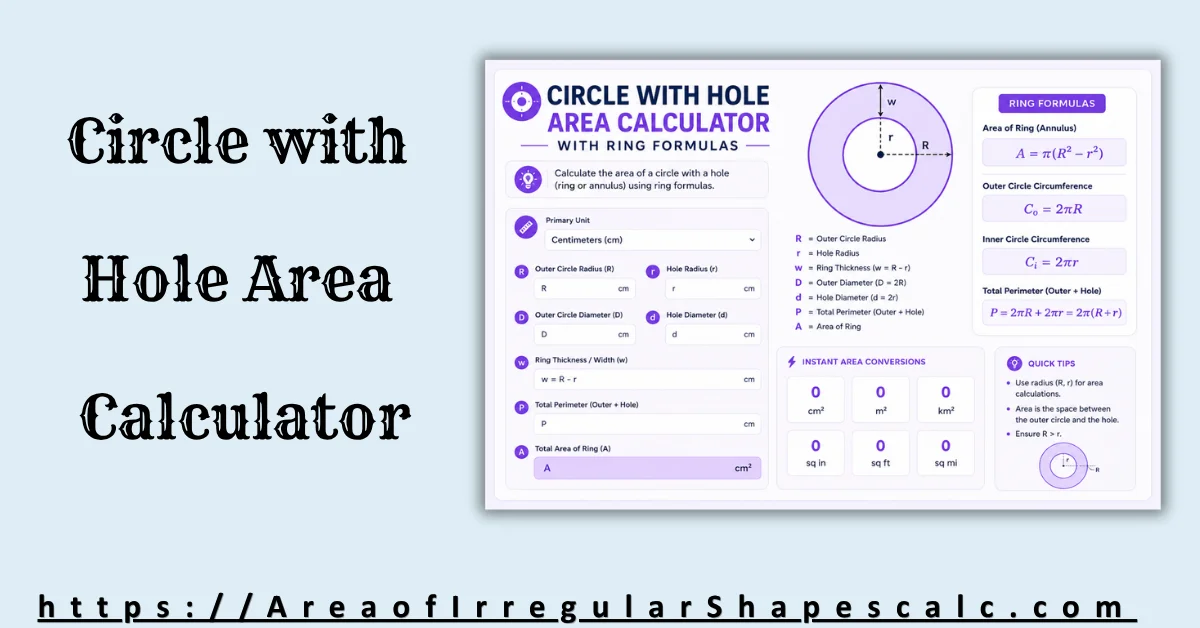
Once the outer and inner measurements are entered, the calculator can automatically determine the remaining ring area along with related circular properties. This saves time while reducing the chances of manual calculation mistakes.
The calculator is especially useful because circle geometry is highly interconnected. If the outer radius and inner radius are known, the calculator can immediately derive the ring thickness, perimeter values, and conversion measurements without requiring additional formulas.
This becomes particularly valuable in engineering and manufacturing environments where circular components often contain internal openings. Pipe systems, mechanical discs, circular plates, rotating machinery, and sealing systems frequently depend on accurate annulus measurements to ensure proper fitting and structural consistency.
In practical projects, solving these values manually can become repetitive very quickly. A dedicated calculator simplifies the process while improving accuracy and consistency.
Formula Used in a Circle with Hole Area Calculator
The main formula used to calculate the area of a circle with a hole is:
\(A = \pi(R^2-r^2)\)
In this equation, \(R\) represents the outer radius, while \(r\) represents the radius of the inner hole. The formula works by subtracting the area of the smaller inner circle from the area of the larger outer circle.
This relationship is easier to understand when visualized practically. Imagine a solid circular metal plate. If a circular hole is drilled through its center, the remaining material forms the annulus. The calculator simply determines how much material remains after the inner section is removed.
For example, suppose the outer radius measures 10 centimeters and the inner radius measures 4 centimeters. The outer circle area becomes:
\(\pi(10^2) = \pi(100)\)
Meanwhile, the inner circle area becomes:
\(\pi(4^2) = \pi(16)\)
Subtracting these values produces:
\(\pi(100-16)\)
which simplifies to:
\(\pi(84)\)
The final area is approximately:
\(263.89 \text{ cm}^2\)
The calculator completes this instantly while also solving additional measurements automatically.
Understanding Ring Thickness and Circular Width
Ring thickness represents the distance between the outer boundary and the inner hole. In engineering systems, this measurement is extremely important because it directly affects structural strength, durability, spacing, and material usage.
The ring thickness formula is:
\(w = R-r\)
This means the thickness equals the outer radius minus the inner radius.
For example, if the outer radius is 12 centimeters and the inner radius is 8 centimeters, the ring thickness becomes:
\(w = 12-8\)
\(w = 4 \text{ cm}\)
Although this calculation appears simple, thickness measurements play a major role in manufacturing and industrial design. A thicker ring generally provides greater strength and resistance, while thinner rings may reduce weight and material cost.
Mechanical engineers often rely on these calculations when designing rotating systems, bearings, turbine components, and circular supports because even small thickness changes can affect overall system performance.
In construction projects, ring thickness may also influence concrete reinforcement layouts, drainage systems, circular foundations, and tunnel structures where balanced spacing is essential.
Total Perimeter of a Circle with a Hole
Unlike a regular circle, a circle with a hole contains two separate curved boundaries. The outer edge creates one circumference, while the inner hole creates another.
The total perimeter formula is:
\(P = 2\pi R + 2\pi r\)
This formula combines both circular boundaries into one total perimeter value.
These measurements become useful when calculating material edges, sealing lengths, circular lining systems, or cutting dimensions. In manufacturing environments, perimeter calculations help determine the amount of edging material, rubber sealing, or circular reinforcement required around both boundaries.
For example, gasket systems and pipe flanges often rely on accurate inner and outer perimeter measurements to maintain proper sealing pressure and alignment.
How to Use the Circle with Hole Area Calculator
The calculator is designed to simplify annulus geometry while reducing repetitive manual work. To begin, enter the measurements for the larger outer circle. Depending on the calculator design, this may involve either the outer radius or outer diameter.
Next, enter the dimensions for the inner hole. The calculator automatically uses these values to determine the remaining ring area and all related measurements.
After selecting the preferred unit system, the calculator instantly computes the total area, perimeter, thickness, and conversion values. Because the formulas are interconnected, users do not need to rearrange equations manually or perform multiple separate calculations.
This becomes especially useful when switching between metric and imperial units during engineering or construction projects. Modern calculators automatically handle these conversions while maintaining consistent accuracy.
In practical situations, this not only saves time but also reduces the likelihood of entering incorrect formulas or inconsistent units.
Engineering and Manufacturing Applications
Circle with hole calculations appear constantly in engineering and industrial systems because hollow circular components are extremely common in practical design.
Washers and spacers provide one of the simplest examples. These components contain a central hole surrounded by a circular ring of material that helps distribute force evenly across mechanical connections. Accurate annulus calculations help determine both material usage and structural balance.
Pipe flanges and gasket systems also rely heavily on circular ring geometry because sealing surfaces must maintain consistent dimensions around both the inner and outer boundaries. Even small errors in thickness or perimeter calculations can create leakage or alignment problems.
Meanwhile, rotating machinery frequently uses annulus-shaped components in bearings, turbines, brake systems, and circular support structures. Because these systems experience rotational stress, balanced ring geometry becomes extremely important for stability and durability.
Pipe and tube engineering relies on this same math to find the cross-sectional area of a pipe wall \u2014 the ring-shaped material between a pipe\u2019s outer diameter and its inner bore. This circular hollow cross-sectional area determines how much metal, plastic, or composite material makes up the pipe wall itself, which matters directly for weight calculations, material cost, and flow-capacity planning.
Construction projects also use circular ring calculations in drainage systems, tunnels, circular foundations, curved pathways, and architectural layouts where hollow circular sections appear naturally within the structure.
Even transportation systems depend on annulus geometry in wheel assemblies, rotating supports, and mechanical spacing systems where precise circular measurements are essential for safe operation.
Common Mistakes When Calculating Circle with Hole Area
Although annulus formulas are mathematically straightforward, mistakes still occur frequently when users misunderstand the geometry or enter incorrect measurements.
One of the most common mistakes involves confusing radius and diameter. Since diameter equals twice the radius, using the wrong measurement can significantly distort the final result. This problem becomes even more serious when both inner and outer circles are involved.
Another common issue occurs when users calculate only the outer circle area without subtracting the inner hole. Since the inner section represents empty space, its area must always be removed from the larger circle.
Unit confusion also creates problems. Ring area must always be expressed using square units such as square centimeters or square feet. Using regular linear units instead of squared units leads to inaccurate reporting.
In some cases, users accidentally enter an inner radius larger than the outer radius. Since the hole cannot exceed the size of the outer circle, this creates impossible geometry. Reliable calculators automatically detect and prevent this issue.
Premature rounding may also reduce precision, especially in engineering systems where tolerances matter. Maintaining full decimal accuracy until the final calculation improves reliability significantly.
Circle with Hole Calculator vs Manual Calculation
Manual annulus calculations can become surprisingly repetitive because multiple interconnected circle formulas must often be solved together. Users may need to calculate outer area, inner area, subtraction values, thickness, circumference, and unit conversions separately before reaching the final answer.
A circle with hole area calculator simplifies this entire process by automating every step. Instead of manually rearranging formulas or repeating calculations, the calculator instantly derives all related values from only a few measurements.
This improves both speed and accuracy, particularly in engineering environments where repeated calculations are common. Manufacturing systems, industrial layouts, rotating machinery, and structural designs often require consistent annulus measurements across multiple components.
Because the calculator automatically handles formulas and conversions together, it reduces human error while improving workflow efficiency.
FAQs
What is a circle with a hole called in geometry?
A circle with a hole is formally called an annulus. It consists of a larger outer circle with a smaller inner circle removed from its center.
How do you calculate the area between two circles?
The formula is:
\(A = \pi(R^2-r^2)\)
where \(R\) is the outer radius and \(r\) is the inner radius.
What is ring thickness?
Ring thickness is the distance between the outer circle and the inner hole. It is calculated using:
\(w = R-r\)
Can the calculator solve perimeter automatically?
Yes. The calculator can determine both inner and outer circumference values along with the combined total perimeter.
Where are annulus calculations used in real life?
Annulus calculations are widely used in engineering, manufacturing, pipe systems, washers, gaskets, turbines, bearings, construction layouts, and rotating machinery.
How do I find the cross-sectional area of a pipe?
A pipe\u2019s cross-sectional area (the wall material, not the open bore) uses the same annulus formula: subtract the area of the inner bore circle from the area of the outer diameter circle. Enter the pipe\u2019s outer and inner radius into this calculator to get the wall\u2019s cross-sectional area directly.
What units are used for ring area?
Ring area uses square units such as:
\(\text{cm}^2\),\(\text{m}^2\),\(\text{ft}^2\),
and\(\text{in}^2\).
Final Thoughts
A circle with hole area calculator simplifies annulus geometry by automatically solving ring-shaped measurements from a few known values. Whether the available measurements include outer radius, inner radius, diameter, thickness, or perimeter, the calculator can instantly determine all related properties while maintaining accurate unit conversions and geometric consistency.
These calculations are widely used in engineering, manufacturing, construction, transportation systems, and industrial design because hollow circular structures appear in countless real-world applications. Manual calculations can quickly become repetitive when multiple interconnected circle formulas must be solved together, especially in precision-focused projects where measurement accuracy matters.
By combining area calculations, perimeter solving, thickness measurements, and automatic conversions into a single tool, the calculator improves efficiency while making complex annulus geometry much easier to manage in both educational and professional environments.