
Oblique Triangle Area Calculator
Calculate the area of an oblique (non-right) triangle using standard and advanced trigonometric formulas. Features a Right-Angle Validator to mathematically check your dimensions.
These dimensions cannot form a valid triangle.
Instant Area Conversions
An oblique triangle is any triangle that does not contain a 90-degree angle. This means both acute triangles and obtuse triangles fall under oblique triangle geometry. Unlike right triangles, oblique triangles do not naturally contain a perpendicular side arrangement, which makes their measurements more difficult to solve directly.
An oblique triangle area calculator helps determine the area of these non-right triangles using methods such as Heron’s formula, side-angle trigonometry, and standard geometric relationships. Since the height of an oblique triangle is often unknown or difficult to measure, calculators simplify the solving process significantly.
Oblique triangles appear frequently in practical engineering and surveying problems because perfectly right-angled structures are less common in real-world layouts. Land boundaries, roof structures, bridge supports, navigation paths, and architectural designs often form irregular triangular shapes where traditional right-triangle methods no longer work efficiently.
Understanding how oblique triangles behave is important because their geometry relies heavily on trigonometry, angle relationships, and indirect measurements rather than straightforward perpendicular dimensions.
Difference Between Right and Oblique Triangles
A right triangle contains one exact 90-degree angle, which creates a natural perpendicular relationship between two sides. Because of this structure, solving right triangles is usually more straightforward.
Oblique triangles behave differently because none of the angles equals 90 degrees. The altitude may fall inside the triangle, outside the triangle, or require additional geometric construction to determine accurately.
This is why formulas for oblique triangles often rely on: trigonometric functions, side-angle relationships, and semi-perimeter calculations.
Your calculator’s built-in right-angle validator becomes especially useful here because many users accidentally attempt to solve right triangles using oblique formulas or vice versa.
Acute vs Obtuse Oblique Triangles
Oblique triangles can be divided into two categories.
An acute oblique triangle contains three angles smaller than 90 degrees. In these triangles, the altitude usually falls inside the shape.
An obtuse oblique triangle contains one angle greater than 90 degrees. In this case, the altitude may extend outside the triangle when constructing perpendicular height lines.
This distinction matters because the geometric behavior changes significantly depending on the angle configuration.
What the Oblique Triangle Area Calculator Solves
An oblique triangle area calculator simplifies several advanced geometry calculations automatically.
The calculator can then determine: total area, perimeter, semi-perimeter, missing dimensions, and trigonometric relationships.
Some calculators also validate whether the triangle is truly oblique. This prevents users from accidentally applying incorrect formulas to right triangles where simpler methods would normally be used.
Because oblique triangle geometry often involves indirect height calculations, the calculator helps eliminate many common trigonometric errors while improving solving speed.
Automatic unit conversion also helps when switching between centimeters, meters, feet, or inches in engineering and construction projects.
Oblique Triangle Area Formulas
Several formulas are commonly used to solve oblique triangle area depending on the information available.
Standard Triangle Area Formula
The standard triangle area formula remains:
\(A=\frac{1}{2}bh\)
Where:
-
A= area -
b= base -
h= perpendicular height
Although this formula still works for oblique triangles, the height is often unknown or difficult to measure directly. This is why additional solving methods become necessary.
Heron’s Formula
When all three side lengths are known, Heron’s formula becomes one of the most useful methods.
The formula is:
\(A=\sqrt{s(s-a)(s-b)(s-c)}\)
Where:
-
A= area -
a,b,c= triangle sides -
s= semi-perimeter
This formula allows the area to be calculated without measuring height directly.
Semi-perimeter Formula
The semi-perimeter is calculated using:
\(s=\frac{a+b+c}{2}\)
The semi-perimeter acts as an intermediate value required for Heron’s formula.
Because all three sides contribute to the calculation, Heron’s method is especially useful in surveying and land measurement applications where side distances are easier to obtain than vertical heights.
Trigonometric Area Formula
When two sides and the included angle are known, the trigonometric area formula is often the most efficient approach.
The formula becomes:
\(A=\frac{1}{2}ab\sin(C)\)
Where:
-
A= area -
aandb= known sides -
C= included angle
This formula works because the sine function helps derive the missing perpendicular height indirectly.
Trigonometric solving becomes especially valuable in navigation, engineering, and structural geometry where angular measurements are often easier to obtain than direct altitudes.
Choosing the Correct Formula
The best formula depends entirely on the measurements available.
If all three sides are known, Heron’s formula is usually the simplest method because no angle measurements are required.
If two sides and an included angle are available, the trigonometric formula becomes more efficient.
The calculator automatically handles these decisions internally, reducing the risk of choosing an incorrect solving method.
How to Use the Oblique Triangle Area Calculator
The calculator is designed to simplify non-right triangle geometry while helping users understand how the measurements connect together.
After selecting the measurement unit, run the calculation. The calculator automatically determines the area, perimeter and semi-perimeter, and related geometric relationships.
Some calculators also include a right-angle validator to confirm whether the triangle is truly oblique. This feature helps prevent formula misuse and improves solving accuracy.
Because oblique triangles often involve trigonometric relationships, calculators reduce the complexity of manual solving significantly.
Understanding Oblique Triangle Geometry
Oblique triangles behave differently from right triangles because their geometry lacks a natural perpendicular structure.
Why Height Is Harder to Measure
In right triangles, the perpendicular sides already provide a visible height relationship.
In oblique triangles, however, the altitude may not align naturally with any side. In some cases, the perpendicular height even falls outside the triangle itself.
This makes direct measurement more difficult and explains why trigonometric formulas are commonly required.
Understanding Included Angles
The included angle is the angle located between the two known sides.
This angle becomes extremely important in trigonometric solving because the sine-area formula depends directly on it.
Using the wrong angle can produce completely incorrect area calculations, which is one reason calculators help reduce solving mistakes.
How Trigonometry Solves Missing Heights
Trigonometric functions allow hidden perpendicular heights to be calculated indirectly.
The sine function, in particular, helps determine the vertical component needed for area calculations without requiring a directly measured altitude.
This relationship is one of the main reasons oblique triangle geometry relies heavily on trigonometry.
Triangle Inequality Explained
Every valid triangle must satisfy the triangle inequality rule.
This means that the the sum of any two sides must always be greater than the third side. If this condition fails, the triangle cannot exist geometrically.
Many calculators automatically validate side relationships before performing calculations.
Real-World Uses of Oblique Triangle Calculations
Oblique triangles appear naturally in many engineering and surveying applications because real-world structures rarely form perfect right angles.
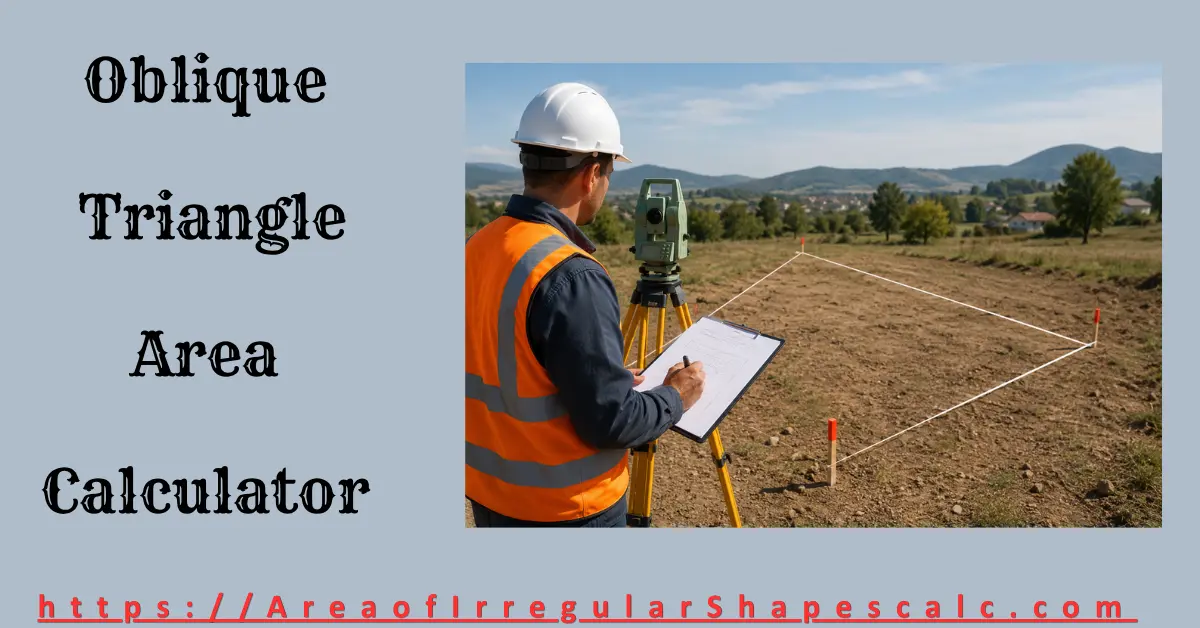
Surveyors frequently use oblique triangle calculations when measuring irregular land boundaries, property divisions, and mapping coordinates. In architecture, roof slopes and support structures often create non-right triangular regions that require trigonometric area calculations.
Navigation systems also rely on oblique triangle geometry when determining directional paths, distances, and angular positioning between locations.
Bridge engineering, structural analysis, and construction planning frequently involve irregular triangular force distributions where side-angle relationships become more important than simple perpendicular measurements.
Because of this, oblique triangle geometry plays a major role in practical measurement systems beyond classroom mathematics.
Common Mistakes When Calculating Area
One common mistake is applying right-triangle formulas to oblique triangles without verifying the angle structure first.
Another frequent issue occurs when users select the wrong included angle while using trigonometric formulas. Since the sine-area formula depends directly on the included angle, incorrect angle selection can significantly distort the final result.
Some users also enter side lengths that violate the triangle inequality rule, creating impossible geometric configurations.
Unit inconsistency may create additional errors when switching between meters, feet, centimeters, or inches.
Finally, rounding intermediate trigonometric values too early can reduce precision in engineering and surveying applications where accuracy matters.
FAQs
What is an oblique triangle?
An oblique triangle is any triangle that does not contain a 90-degree angle.
Is an obtuse triangle considered oblique?
Yes. Both acute and obtuse triangles are classified as oblique triangles.
Why is trigonometry needed for oblique triangles?
Because the perpendicular height is often unknown or difficult to measure directly.
When should Heron’s formula be used?
Heron’s formula works best when all three side lengths are known.
Can area be calculated without height?
Yes. Heron’s formula and trigonometric formulas allow area calculations without directly measuring height.
How does the right-angle validator work?
The validator checks whether the triangle contains a 90-degree angle and confirms whether oblique formulas are appropriate.
Final Thoughts
An oblique triangle area calculator simplifies one of the most important forms of non-right triangle geometry by automatically connecting side lengths, angles, semi-perimeter relationships, and trigonometric calculations.
Because oblique triangles lack natural perpendicular structure, manual solving can quickly become difficult, especially in engineering, surveying, and construction environments. A calculator helps reduce these complexities while improving both speed and accuracy.
Whether you are solving geometry problems, measuring irregular land boundaries, analyzing roof structures, or working with engineering layouts, the calculator provides a reliable and practical way to calculate oblique triangle area accurately.