
Irregular Land / Plot Area Calculator
Calculate the exact area of an irregular land plot, field, or property — whether you have corner coordinates, just the side lengths plus one diagonal (the classic “4 unequal sides” land-survey method), or side lengths with interior angles from a survey. Results are shown in m², ft², yd², acres, hectares, and cents, with a live scaled drawing of your plot.
Enter the X and Y coordinate of each corner, in order, as you move around the plot’s boundary. Best if you have a survey map or GPS points.
| # | X | Y |
|---|
Use this when you have measured the side lengths of the plot (a “4 unequal sides” or “different sides” plot) but not the coordinates or angles. This is the standard land-survey method: the plot is split into triangles using one or more diagonals measured from corner #1, and each triangle’s area is found with Heron’s formula. For the common 4-sided plot, you only need the 4 side lengths and 1 diagonal.
| Side | From → To | Length |
|---|
| Diagonal | From → To | Length |
|---|
Use this when you know each side’s length and the interior angle at each corner, as recorded in a land-survey traverse. The angle at Point 1 only sets the drawing’s rotation and does not affect the calculated area, so it is left out.
| Point | Interior Angle (°) | Length of Side to Next Point |
|---|
When people think about measuring land, they often imagine a simple rectangle—four straight sides, clear angles, and an easy formula. But in reality, most plots are far from perfect.
Boundaries shift, sides are unequal, and corners rarely meet at clean right angles. This is exactly why so many people end up searching for an irregular plot area calculator or a reliable way to calculate irregular land area.
The real challenge is not the formula—it is understanding how to approach the shape. Once you understand that, even the most uneven or odd-sized plot becomes manageable.
What Is an Irregular Land Plot?
An irregular plot is any piece of land that does not follow standard geometric shapes like squares or rectangles. In practical terms, this means the sides may be of different lengths, angles may not be 90 degrees, and the boundary may include extensions or cuts.
This is extremely common in real life. Agricultural land, residential plots, corner lots, and inherited land divisions often result in irregular shapes. So when users look for an irregular land area calculator, they are usually trying to solve a real measurement problem—not a theoretical one.
Understanding this is important, because the calculation method depends entirely on how you interpret the shape.
Why Calculating Irregular Land Area Feels Difficult
The difficulty arises before any calculation begins.
When you look at an irregular plot, it is not immediately clear what measurements to take. Unlike a rectangle, there is no single length and width that defines the entire area. Instead, you are dealing with multiple sides and angles at once.
This creates confusion such as:
Where should measurement start? Which sides matter? Can a single formula even work here?
These questions are exactly why people search for how to calculate irregular land area or how to measure irregular plot size. The issue is not complexity of math—it is lack of structure in the approach.
The Correct Way to Calculate Irregular Plot Area
Instead of trying to solve the entire plot at once, the correct approach is to simplify it.
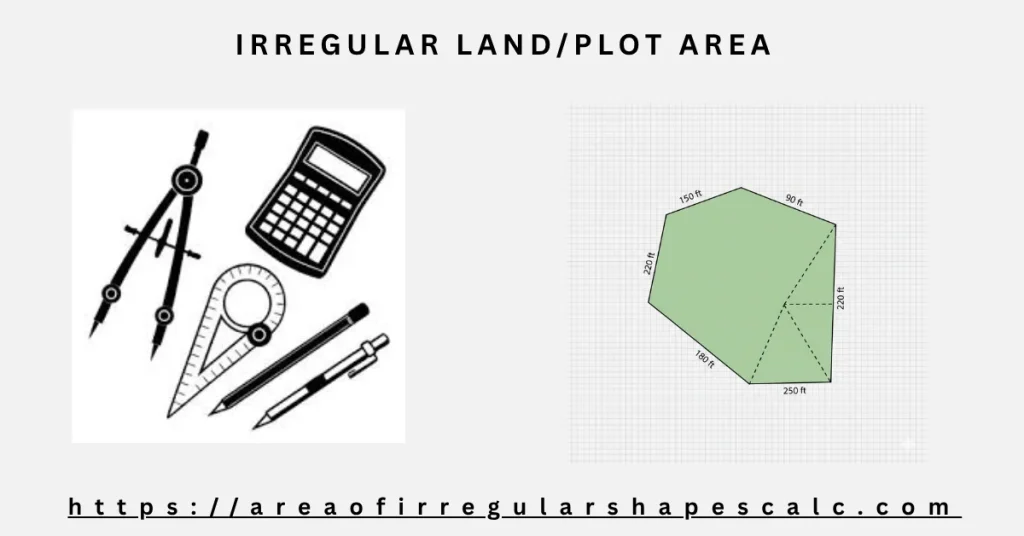
Start by visualizing the land as a combination of smaller, regular shapes. Even the most complex plot can be broken into rectangles, triangles, or trapezoids. This step is crucial because it converts an irregular problem into multiple simple ones.
Once divided, measure each section individually. Calculate the area of each part using basic formulas, and then combine all the results to get the total plot area.
This method is the foundation behind every reliable irregular plot area calculator. It is not guessing—it is structured calculation.
How to Calculate Land Area With 4 Unequal Sides (the Diagonal / Triangulation Method)
Most people who search for a way to calculate area from 4 different sides have exactly this situation: a plot with four unequal sides and no coordinates. The oldest and most reliable solution is the method surveyors have used for centuries — split the plot into two triangles using one diagonal, then use Heron's formula on each triangle.
Here is the full method, step by step:
Step 1: Measure the four sides in order around the plot. Call them a, b, c, and d.
Step 2: Measure one diagonal — a straight line across the plot connecting the first corner to the third corner. Call this measurement e. This single extra measurement is what makes the shape solvable; four side lengths alone do not fix a unique area, because a four-sided shape can flex like a hinge unless a diagonal (or an angle) pins it in place.
Step 3: The diagonal splits the plot into two triangles. Find the area of each triangle with Heron's formula. For a triangle with sides p, q, and r:
s = (p + q + r) ÷ 2 (this is the semi-perimeter of the triangle)
Area = the square root of [ s × (s − p) × (s − q) × (s − r) ]
Step 4: Add the two triangle areas together. That sum is the total area of the plot.
Worked example: a plot has four sides measuring 6 m, 4.5 m, 6.4 m, and 5 m, in order, with a diagonal of 7.8 m connecting the first and third corners.
Triangle 1 (sides 6 m, 4.5 m, 7.8 m): s = 9.15, Area ≈ 13.45 m²
Triangle 2 (sides 7.8 m, 6.4 m, 5 m): s = 9.6, Area ≈ 15.95 m²
Total area ≈ 13.45 + 15.95 = 29.40 m²
This is exactly the example already loaded in the "Sides + Diagonal" tab of the calculator above — switch to that tab and click Calculate Area to see the same result worked out automatically, along with the shape drawn to scale. For a plot with more than four sides, the same idea extends naturally: you simply need one additional diagonal for every extra side, all measured from the same starting corner, which the calculator handles for you when you add more rows.
How to Measure Irregular Land Accurately
Before calculation, measurement must be correct. Even the best method fails if the input is wrong.
In real-world scenarios, land measurement is usually done using measuring tape, laser tools, GPS devices, or professional surveying methods. The goal is to capture accurate lengths of all sides and, if possible, key diagonals.
One important principle is to avoid estimating by eye. Irregular land often looks simpler than it actually is, and visual approximation leads to errors that affect the final area significantly.
Accurate measurement is what transforms a confusing shape into a solvable problem.
Using an Irregular Land Area Calculator
Once measurements are available, using an irregular land area calculator becomes the most efficient option.
Instead of manually dividing the plot and calculating each section, you can input dimensions into the calculator and let it compute the total area automatically. This not only saves time but also reduces the chances of human error.
For most users—especially those dealing with property, construction, or planning—this approach provides a balance between speed and accuracy.
Calculating Plot Area Using Coordinates
In some cases, especially for surveyors or technical users, land is defined using coordinates rather than direct measurements.
This is where coordinate-based calculation becomes useful. By marking points of the plot on a map and using their coordinates, the area can be calculated mathematically without breaking the shape into visible sections.
This method is highly accurate and is commonly used in mapping systems, GIS tools, and land surveys. It is also the logic behind many advanced area calculator tools. The "Coordinates (X, Y)" tab in the calculator above uses exactly this method — enter each corner's X and Y value in order and the total area is computed instantly.
How to Calculate Acreage of an Irregular Lot
Once the total area is calculated, it is often necessary to convert it into standard units such as acres.
This is particularly relevant in real estate and agriculture, where land is commonly measured in acres rather than square feet or square meters.
The process is simple: calculate the total area first, then convert it using the appropriate unit conversion. However, accuracy at the calculation stage remains critical, because any error carries forward into the final acreage.
For reference: 1 acre = 43,560 square feet = 4,046.86 square meters = 100 cents (the cent is a common land unit in India and other parts of South Asia). 1 hectare = 2.471 acres = 10,000 square meters. The calculator above converts to all of these units automatically the moment you click Calculate Area — including cents — so there is no need to do this conversion by hand.
Corner Plots, Splay Corners, and "Odd Site" Terminology
Not every irregular plot looks the same, and the terminology used to describe them varies by region and by industry.
A corner plot sits where two roads meet, and it often has a cut or angled corner — commonly called a splay — where the two street-facing boundaries are joined by a short diagonal edge instead of a sharp right angle. Property listings, planning documents, and some regional building codes also use terms like odd site, odd-shaped plot, or unshaped land to describe any lot that departs from a simple rectangle.
None of these are a special case mathematically. A corner plot with a splay is simply a polygon with one extra short side where the sharp corner would otherwise be, and an "odd site" is just another name for an irregular plot. You measure both the same way as any other irregular plot: log the coordinates of every corner, including the splay's two endpoints, and use the Coordinates tab — or measure every side plus one diagonal per extra corner and use the Sides + Diagonal tab.
Common Mistakes in Irregular Land Area Calculation
Most mistakes do not come from formulas—they come from incorrect assumptions.
A common error is treating the entire plot as a single shape instead of dividing it into smaller sections. Another is missing minor extensions or irregular edges that seem insignificant but contribute to total area.
There is also a tendency to mix units or rely on rough estimates instead of proper measurement. A related mistake specific to the "4 sides" method is assuming that four side lengths are enough on their own — without a diagonal or an angle, a four-sided shape is not rigid, so its area cannot be pinned down exactly.
Avoiding these mistakes is often more important than learning new formulas.
When to Use a Plot Area Calculator Instead of Manual Calculation
Manual calculation works when the shape is simple and measurements are clear. But as soon as the plot becomes irregular, the effort required increases significantly.
If the land includes multiple sides, uneven boundaries, or complex geometry, using a plot area calculator is the more practical choice. It simplifies the process, ensures consistency, and delivers faster results.
FAQs
How do you calculate irregular land area?
Break the plot into smaller regular shapes, calculate each section, and add them together to get the total area.
How do you measure an irregular plot of land?
Measure all sides accurately using tools like tape, GPS, or surveying instruments, and avoid estimation.
Can I calculate land area using coordinates?
Yes, coordinate-based methods allow accurate calculation without manually dividing the shape. Use the Coordinates (X, Y) tab in the calculator above.
How do you calculate acreage of an irregular lot?
First calculate the total area in square units, then convert it into acres using standard conversion factors (1 acre = 43,560 square feet = 4,046.86 square meters).
What is the easiest way to calculate irregular plot area?
Using an irregular plot area calculator is the easiest and most reliable method when accurate measurements are available.
How do I calculate area from 4 unequal sides?
Measure the four sides plus one diagonal that splits the plot into two triangles, then find each triangle's area with Heron's formula and add them together. Use the Sides + Diagonal tab above to do this automatically.
Do I need a diagonal to calculate a 4-sided plot's area?
Yes, if you only have coordinates or angles, you do not need one — but from side lengths alone you do. Four side lengths do not fix a unique shape on their own, since the shape can flex like a hinge; a diagonal (or one interior angle) is what pins the area down to a single, correct value.
How do I calculate plot area in square feet?
Enter your measurements in whichever unit you measured them (meters, centimeters, feet, or yards) and click Calculate Area — the result is shown in square meters, square feet, square yards, acres, hectares, and cents all at once, so no manual conversion is needed.
What is a corner plot, and how do I calculate its area?
A corner plot is a lot bordered by two roads, often with an angled "splay" corner where they meet. It is calculated the same way as any irregular plot — with coordinates or with side lengths plus a diagonal.
What does "odd site" mean?
"Odd site" and "odd-shaped plot" are regional terms for a plot that is not a simple rectangle. The same calculation methods on this page apply regardless of what the shape is called.
How many cents are in an acre?
100 cents equal 1 acre (about 4,046.86 square meters). The cent is a land measurement unit widely used in India and neighboring countries, and it is included as an automatic conversion in the calculator above.
Can I calculate area if I only know the interior angles and side lengths?
Yes. This is the traverse method used in land surveys — use the Sides + Angles tab above, enter each side's length and the interior angle at each corner, and the area and perimeter are calculated automatically.