
Obtuse Triangle Area Calculator
Calculate the area of an obtuse triangle. Includes a built-in Obtuse Validator to confirm if your triangle actually contains an angle greater than 90 degrees.
These side lengths cannot form a closed triangle. The sum of any two sides must be strictly greater than the third side.
Instant Area Conversions
An obtuse triangle is a triangle that contains one angle greater than 90 degrees. Unlike acute triangles, where every angle remains below 90 degrees, or right triangles, which contain exactly one 90-degree angle, an obtuse triangle has a wider and more stretched appearance because one corner opens beyond a right angle.
This change in shape affects the triangle’s geometry in several important ways. The height may fall outside the triangle, side relationships become less visually intuitive, and area calculations often require different approaches depending on the available measurements.
An obtuse triangle area calculator helps simplify these calculations by automatically determining the area from known values such as side lengths, base and height, or perimeter-related measurements. Your calculator also includes an obtuse triangle validator, which confirms whether the given side configuration actually forms an obtuse triangle. This is an important feature because not every triangle with three valid sides is geometrically obtuse.
In practical situations, obtuse triangles appear in irregular land layouts, angled roof structures, road intersections, mapping systems, and construction designs where measurements rarely form perfect right angles.
How Obtuse Triangles Differ from Other Triangle Types
The defining characteristic of an obtuse triangle is the presence of one angle larger than 90 degrees. Because the total angle sum of any triangle is always 180 degrees, the remaining two angles must both be acute.
This geometric structure changes the placement of the altitude. In many obtuse triangles, the perpendicular height extends outside the triangle itself rather than remaining inside the shape. As a result, manual area calculations can become more confusing, especially for beginners.
This is one reason why Heron’s formula becomes especially useful for obtuse triangles. Instead of requiring the height directly, the formula allows the area to be calculated using only the three side lengths.
What the Obtuse Triangle Area Calculator Solves
An obtuse triangle area calculator is designed to reduce manual geometry work while helping users verify the triangle’s structure at the same time.
Once the known measurements are entered, the calculator can instantly determine the total area and convert the result into multiple unit systems. More importantly, the built-in validator helps confirm whether the triangle truly contains an angle greater than 90 degrees.
This validation step is extremely valuable because users often assume a triangle is obtuse based only on appearance. In reality, many side combinations form acute or impossible triangles instead.
The calculator also helps avoid common mathematical errors. In irregular triangles, obtaining an accurate height measurement is not always practical. Surveyors, architects, and students frequently know only the side lengths, which makes Heron’s formula the preferred calculation method.
In real-world applications, this type of calculation is useful when measuring irregular plots of land, planning angled support structures, designing sloped roofing sections, or analyzing geometric layouts that do not follow symmetrical patterns.
Obtuse Triangle Area Formulas
The area of an obtuse triangle can be calculated using several methods depending on the information available.
Formula Using Base and Height
If the base and perpendicular height are known, the standard triangle area equation can be used.
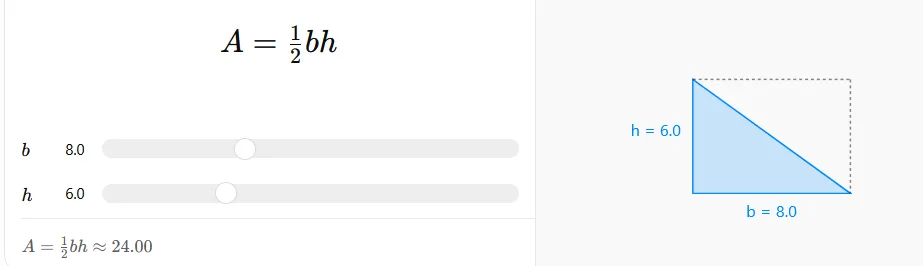
In this formula:
-
\(A\) represents the area,
-
\(b\) represents the base,
-
\(h\) represents the perpendicular height.
Although the formula itself is simple, measuring the height of an obtuse triangle can sometimes be difficult because the altitude may extend outside the triangle. In construction and surveying work, this often makes direct measurement less convenient.
Heron’s Formula for Obtuse Triangles
When all three sides are known, Heron’s formula becomes one of the most effective methods for calculating area.
\(A = \sqrt{s(s-a)(s-b)(s-c)}\)
Here:
-
\(a\), \(b\), and \(c\) are the side lengths,
-
\(s\) represents the semiperimeter.
The semiperimeter is calculated as:
\(s = \frac{a+b+c}{2}\)
Heron’s formula is especially useful for obtuse triangles because it removes the need to measure height directly. This becomes important in irregular geometry where vertical measurements are difficult to obtain accurately.
For example, surveyors measuring an uneven triangular land section may know the boundary lengths but not the internal height. In this situation, Heron’s formula provides a much more practical solution.
Why Heron’s Formula Works Well for Obtuse Triangles
Many triangle calculators rely heavily on base and height inputs. However, obtuse triangles often create measurement complications because the perpendicular altitude falls outside the shape.
Heron’s formula bypasses this problem entirely by working only with side lengths. This makes it one of the most versatile formulas in geometry, especially for irregular triangles where direct height measurement is inconvenient or impossible.
Because of this flexibility, Heron’s formula is widely used in surveying, engineering, mapping, construction planning and geometric modeling.
How to Use the Obtuse Triangle Area Calculator
The calculator is designed to simplify both area calculation and triangle validation.
Start by selecting the type of information you already know. Most users enter all three side lengths, especially when using Heron’s formula. After choosing the measurement unit, enter the values carefully and run the calculation.
The calculator automatically checks whether the side lengths form a valid triangle. It then determines whether one angle exceeds 90 degrees. If the triangle qualifies as obtuse, the calculator proceeds with the area calculation and displays the result instantly.
Many calculators also provide automatic area conversions into square centimeters, square meters, square feet, and other common units. This feature helps users compare measurements across different systems without performing manual conversions.
The validation feature is particularly useful because invalid side combinations are surprisingly common. A triangle may appear visually obtuse while mathematically failing the triangle inequality condition altogether.
By combining geometry validation with area calculation, the tool becomes much more reliable than a basic formula-only calculator.
Understanding Obtuse Triangle Geometry
Obtuse triangles behave differently from regular, equilateral, or right triangles because of their wider angle structure.
Why the Height May Fall Outside the Triangle
In acute triangles, the altitude usually remains inside the triangle. In obtuse triangles, however, the perpendicular height often extends beyond the triangle’s boundary.
This occurs because the obtuse angle pushes the opposite side farther outward, changing the internal geometry. As a result, measuring height manually becomes less intuitive.
This is one reason why many students struggle with obtuse triangle area problems even when they understand the standard area formula.
Understanding the Largest Angle
An obtuse triangle can contain only one obtuse angle. If two angles exceeded 90 degrees, the total would surpass the triangle’s 180-degree limit.
The side opposite the obtuse angle is always the longest side of the triangle. This relationship becomes useful when validating whether a triangle is actually obtuse.
Triangle Inequality and Validation
Not every combination of three side lengths forms a valid triangle.
For a triangle to exist the sum of any two sides must exceed the third side. If this condition fails, the triangle becomes geometrically impossible.
Your calculator’s validator helps detect these invalid configurations automatically before attempting area calculations.
Real-World Applications of Obtuse Triangle Calculations
Obtuse triangles appear naturally in many irregular measurement environments where angles are not perfectly symmetrical.
In surveying and land measurement, property boundaries frequently form obtuse triangular sections. Calculating these areas accurately helps estimate land coverage, fencing requirements, irrigation layouts, and development planning.
Construction projects also rely on obtuse triangle calculations when dealing with sloped roof extensions, angled support beams, or irregular framing structures. In these situations, side-based calculations are often more practical than direct height measurements.
Road and transportation engineering provides another common example. Intersections, curved pathways, and diagonal support layouts may create obtuse geometric sections that require accurate area estimation during planning and mapping.
Even digital applications such as CAD modeling, 3D rendering, and geometric design software regularly use obtuse triangle calculations when working with irregular polygon structures.
Common Mistakes When Calculating Obtuse Triangle Area
One of the most common mistakes is assuming that every irregular triangle is automatically obtuse. In reality, the triangle must contain one angle greater than 90 degrees, which depends entirely on the side relationships.
Another frequent problem involves incorrect height placement. Since the altitude may extend outside the triangle, users sometimes measure the wrong perpendicular distance and produce inaccurate area values.
Formula confusion also creates issues. Some users apply right triangle formulas to obtuse triangles even though the geometric relationships are different. This can lead to significant errors in engineering or construction calculations.
Unit inconsistency is another common source of mistakes. Entering side lengths in one measurement system while interpreting results in another can distort area estimates considerably.
Finally, rounding values too early during intermediate calculations may reduce overall precision. Maintaining decimal accuracy until the final result usually produces more reliable measurements.
FAQs
What makes a triangle obtuse?
A triangle is considered obtuse when one interior angle is greater than 90 degrees.
Can an obtuse triangle have equal sides?
No. An equilateral triangle always contains three 60-degree angles, so it cannot be obtuse.
Why is Heron’s formula useful for obtuse triangles?
Heron’s formula calculates area using only side lengths, making it ideal when the height is difficult to measure.
Can the height fall outside the triangle?
Yes. In obtuse triangles, the perpendicular altitude often extends beyond the triangle’s boundary.
How does the calculator validate the triangle?
The calculator checks whether the side lengths form a valid triangle and confirms whether one angle exceeds 90 degrees.
Can an obtuse triangle become impossible geometrically?
Yes. If the side lengths violate the triangle inequality rule, a valid triangle cannot exist.
Final Thoughts
An obtuse triangle area calculator does more than solve a geometry formula. It helps users validate triangle structure, simplify complex measurements, and understand how irregular triangle geometry behaves in practical situations.
Because obtuse triangles often involve difficult height placement and irregular side relationships, calculators that support Heron’s formula and automatic validation provide a major advantage. They reduce manual errors while making geometry more accessible for students, engineers, surveyors, and construction professionals alike.
Whether you are solving educational problems, measuring land boundaries, planning structural layouts, or analyzing geometric designs, the calculator provides a faster and more reliable way to calculate obtuse triangle area accurately.