Ultimate Annulus (Hollow Circle) Area Calculator
Type any two known values to instantly solve the rest. Our multi-directional logic handles the complex geometry automatically.
Instant Area Conversions
Engineering & Geometry
An annulus is a hollow circular shape formed when a smaller circle is removed from the center of a larger circle. The remaining ring-shaped region is called an annulus. In practical geometry, it is also commonly referred to as a hollow circle or circular ring.
An annulus area calculator helps determine the area of this ring-shaped region using measurements such as: outer radius, inner radius, diameter, thickness, or circumference relationships.
Because annulus geometry combines two circles simultaneously, the calculations become more complex than standard circle area formulas. The calculator simplifies these relationships automatically while helping users understand how the inner and outer measurements interact.
Annulus geometry appears frequently in engineering and manufacturing because many real-world components naturally contain hollow circular sections. Pipes, washers, bearings, mechanical seals, circular tracks, and industrial tubing systems all rely heavily on annulus calculations.
Understanding how annulus geometry works is especially important in structural engineering and industrial design because thickness and cross-sectional area strongly affect material strength, fluid flow, and mechanical performance.
Difference Between a Circle and a Hollow Circle
A standard circle contains a fully enclosed area extending from the center to the outer boundary.
An annulus behaves differently because part of the interior area is removed. The inner hole creates a second circular boundary, leaving only the ring-shaped region between the two circles.
This means annulus geometry always contains: an outer circle, an inner circle, and the remaining hollow ring between them.
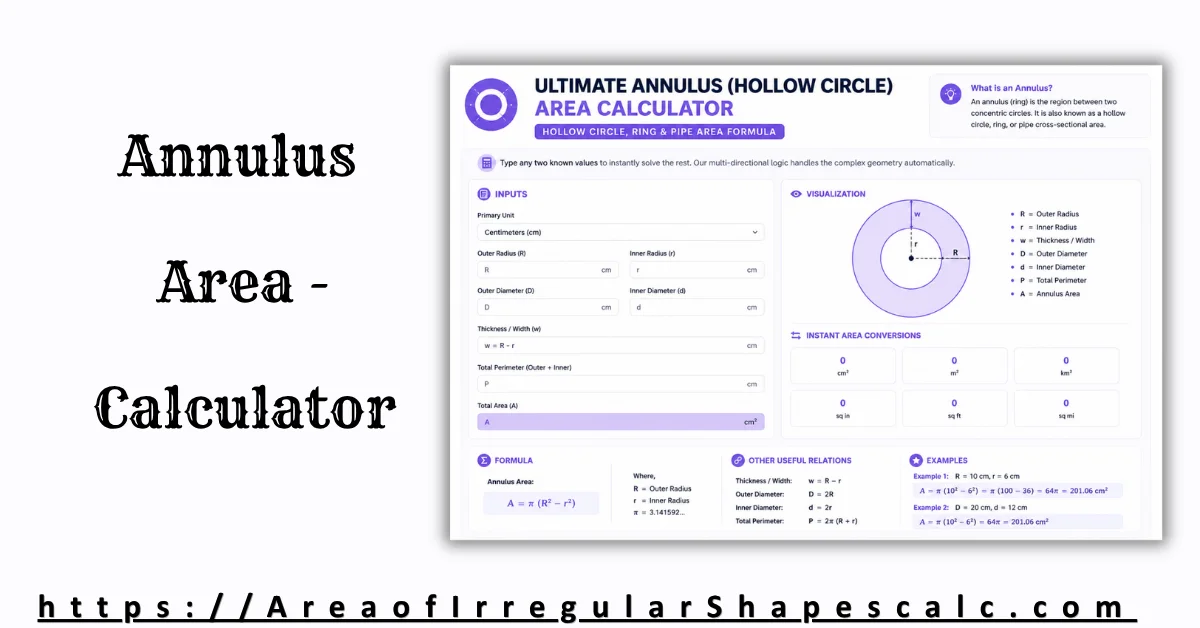
Because of this structure, annulus calculations rely on subtracting the smaller circular area from the larger one.
Understanding Inner and Outer Radius
The outer radius measures the distance from the center to the outer boundary of the annulus.
The inner radius measures the distance from the center to the inner hole.
The difference between these two radii determines the thickness or width of the ring.
As the inner radius grows larger: the hollow opening expands, the remaining annulus area becomes smaller, and the ring becomes thinner.
This relationship is especially important in engineering systems where wall thickness directly affects strength, durability, and fluid capacity.
What the Annulus Area Calculator Solves
An annulus area calculator simplifies several interconnected hollow-circle calculations automatically.
Most users begin by entering: outer radius and inner radius, outer diameter and inner diameter, or thickness and radius relationships.
The calculator can then determine:
-
annulus area, ring thickness, outer circumference, inner circumference, and related geometry measurements.
Some advanced calculators also calculate total perimeter relationships by combining both circular boundaries.
Because all annulus properties are mathematically connected, changing one measurement automatically affects the others.
This becomes especially useful in engineering and manufacturing environments where hollow circular structures must maintain precise dimensional relationships.
Automatic area conversion also helps users switch between: centimeters, meters, feet, and inches depending on project requirements.
Annulus Formulas
Several formulas work together when calculating annulus geometry.
Annulus Area Formula
The standard annulus area formula is:
A=\pi(R^2-r^2)
Where:
-
A= annulus area -
R= outer radius -
r= inner radius
This formula works by subtracting the inner circular hole area from the larger outer circle area.
For example:
-
the outer circle area equals
\pi R^2, -
the inner hole area equals
\pi r^2.
The remaining region becomes the annulus itself.
Thickness Formula
The ring thickness or width is calculated using:
w=R-r
Where:
-
w= thickness -
R= outer radius -
r= inner radius
This measurement determines how wide the annular ring becomes. In practical engineering systems, thickness often controls material strength, pressure resistance, and structural stability.
Outer Circumference Formula
The outer circumference is calculated using:
C=2\pi R
Where:
-
C= outer circumference -
R= outer radius
This measures the total distance around the outer boundary of the annulus.
Inner Circumference Formula
The inner circumference is:
C=2\pi r
Where:
-
r= inner radius
This represents the perimeter surrounding the hollow opening.
Because annulus geometry contains two circular boundaries, both circumferences become important in engineering calculations.
Why Annulus Geometry Uses Area Subtraction
An annulus is fundamentally a difference between two circles. The larger circle provides the outer boundary, while the smaller circle removes part of the interior area.
As a result, the remaining ring-shaped geometry can only be calculated correctly through subtraction. This explains why increasing the inner radius decreases the annulus area even when the outer radius remains unchanged.
How to Use the Annulus Area Calculator
The calculator is designed to simplify hollow-circle geometry while helping users understand how the measurements connect together.
Begin by entering any known measurements such as outer radius and inner radius, outer diameter and thickness, or circumference relationships.
After selecting the preferred unit system, run the calculation. The calculator automatically determines: annulus area, ring width, outer circumference, inner circumference, and related geometry measurements.
Because all annulus properties are interconnected, changing one value updates the remaining geometry dynamically. This process becomes especially useful in industrial and engineering projects where dimensions must satisfy precise manufacturing tolerances.
Understanding Hollow Circle Geometry
Annulus geometry behaves differently from standard circle geometry because it contains both an outer boundary and an internal hollow region.
How Inner and Outer Circles Interact
The outer circle defines the maximum size of the annulus, while the inner circle removes material from the center.
As the inner circle expands: the annulus becomes thinner, the remaining area decreases, and the geometry gradually approaches a narrow ring. If the inner radius becomes very small, the annulus behaves more like a full circle.
This interaction between the two circles forms the foundation of annulus geometry.
Why Thickness Changes Area Rapidly
Thickness directly controls how much material remains inside the annulus. Even relatively small thickness increases can significantly increase: total area, structural mass,
-
and cross-sectional strength.
Because area depends on squared radius relationships, annulus geometry changes nonlinearly as the dimensions grow.
Ring Width and Structural Behavior
In engineering systems, ring width often determines load distribution, pressure tolerance, rotational stability, and material performance.
Thin annular sections behave differently from thick annular sections under stress and pressure.
This is why annulus calculations appear frequently in mechanical engineering and industrial manufacturing.
Cross-Sectional Geometry Explained
Many hollow cylindrical systems rely on annulus cross-sections.
For example, pipe walls form annular regions between the outer pipe surface, and the internal hollow opening.
Cross-sectional annulus area becomes extremely important in fluid mechanics, thermal systems, structural engineering, and manufacturing design.
Real-World Uses of Annulus Calculations
Annulus geometry appears naturally in many industrial and engineering environments because hollow circular systems are extremely common.
Pipe and tube engineering frequently relies on annulus calculations to determine wall thickness, fluid flow capacity, and structural strength. Mechanical washers and bearings also use annular geometry because ring-shaped components distribute loads evenly around rotating systems.
Roadway and circular track systems sometimes use annulus geometry when designing ring-shaped layouts, curved pathways, and circular infrastructure regions.
Aerospace and industrial manufacturing systems also depend heavily on annulus calculations because hollow cylindrical structures often provide high strength while reducing weight and material usage.
Because of this, annulus geometry plays a major role in practical engineering design far beyond classroom mathematics.
Common Mistakes When Calculating Area
One common mistake is confusing radius and diameter. Since diameter equals twice the radius, using the wrong measurement can significantly distort the calculations.
Another issue occurs when users forget to subtract the inner circle area. Calculating only the outer circle produces incorrect annulus area values.
Incorrect thickness measurements can also affect results because ring width directly controls the remaining area.
Some users overlook the fact that annulus geometry contains two circumferences rather than one, which can create confusion in perimeter calculations.
Finally, unit conversion mistakes may occur when switching between inches, feet, meters, or centimeters.
FAQs
What is an annulus?
An annulus is a ring-shaped region formed by removing a smaller circle from the center of a larger circle.
How is annulus area calculated?
The formula is:
A=\pi(R^2-r^2)
What is annulus thickness?
Thickness is the difference between the outer radius and inner radius.
Why is the inner circle subtracted?
Because the inner circle represents the hollow area removed from the larger circle.
What is the difference between inner and outer circumference?
The outer circumference measures the external boundary, while the inner circumference measures the boundary surrounding the hollow opening.
Where are annulus calculations used in real life?
Annulus geometry appears in pipes, washers, bearings, circular tracks, aerospace systems, and industrial manufacturing.
Final Thoughts
An annulus area calculator simplifies hollow-circle geometry by automatically connecting outer radius, inner radius, thickness, circumference, and area relationships.
Because annulus geometry involves two interacting circles, manual calculations can quickly become difficult, especially in engineering and manufacturing applications where precision matters. The calculator helps reduce these complexities while improving both speed and accuracy.
Whether you are working with pipe systems, mechanical components, industrial structures, or circular engineering layouts, the calculator provides a reliable and efficient way to calculate annulus geometry accurately.