
Triangle Area Calculator (Coordinates)
Enter the Cartesian $(x,y)$ coordinates for the three vertices of a triangle to calculate its area using the Shoelace Formula.
These three coordinates form a straight line. They do not close to form a valid 2D triangle, so the area is exactly 0.
Instant Area Conversions
How to Calculate Triangle Area from Coordinates
When a triangle is defined by its vertices (points) on a Cartesian coordinate plane, you don't need to manually calculate the base or height. Instead, you can use a powerful tool called the Shoelace Formula (also known as Gauss's area formula).
The Shoelace Formula
Given three points $(x_1, y_1)$, $(x_2, y_2)$, and $(x_3, y_3)$, the area is found by cross-multiplying the coordinates:
Note: The absolute value `| |` ensures the area is always positive, regardless of the order you list the points.
What are Collinear Points?
If you plot three points and they happen to fall on the exact same straight line, they cannot form a closed triangle. In mathematics, these are called collinear points. If you run the Shoelace formula on collinear points, the calculated area will be exactly 0.
A triangle area calculator using coordinates helps calculate the area of a triangle directly from its vertex positions on the Cartesian plane. Instead of requiring side lengths or perpendicular height, the calculator uses coordinate geometry relationships to determine the enclosed area automatically.
This method is especially useful when working with graph-based geometry, coordinate systems, mapping applications, CAD layouts, engineering designs, and spatial mathematics.
The calculator typically uses the Shoelace Formula, which calculates area from the ordered coordinates of the three vertices. Because the geometry already exists visually on the graph, the side lengths and height can be derived mathematically without direct measurement.
Coordinate triangle calculations appear frequently in GIS mapping, architecture, computer graphics, robotics, surveying, and navigation systems where geometric shapes are defined using point locations instead of physical dimensions.
Understanding how coordinates determine area is important because graph geometry behaves differently from traditional side-and-height triangle calculations.
What Is Coordinate Geometry?
Coordinate geometry combines algebra and geometry using a graph system called the Cartesian plane.
Each point on the graph contains: an x-coordinate representing horizontal position, and a y-coordinate representing vertical position.
When three coordinate points are connected, they form a triangle on the XY plane. The area of the triangle depends entirely on the spatial relationship between those points.
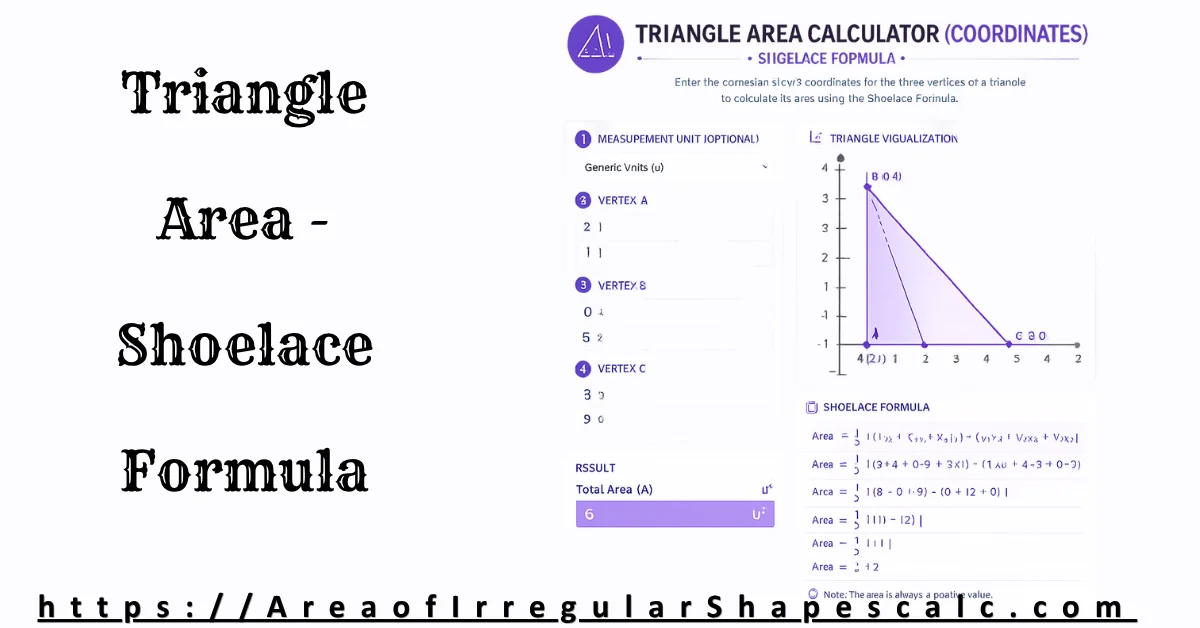
As the vertices move the side lengths change, the internal angles shift, and the enclosed area adjusts automatically.
This relationship allows graph-based geometry to be solved mathematically using coordinates alone.
How Coordinates Create Triangles
Every coordinate pair represents a fixed position on the graph.
For example:
-
(x₁,y₁) -
(x₂,y₂) -
(x₃,y₃)
represent the three triangle vertices.
Connecting these points forms the geometric boundaries of the triangle.
The positions of the vertices determine:
-
shape,
-
orientation,
-
side lengths,
-
angles,
-
and enclosed area.
Because the coordinate system already contains spatial distance information, the calculator can determine area without manually measuring height or side dimensions.
Why Side Lengths Are Not Required
Many users assume triangle area always requires base, height, or side measurements.
In coordinate geometry, however, the vertex positions already contain all the necessary geometric information.
The Shoelace Formula extracts area directly from the coordinate relationships without explicitly calculating side lengths first.
This makes coordinate-based solving especially useful in graph systems where the shape is defined visually rather than physically measured.
What the Triangle Area Calculator (Coordinates) Solves
A coordinate triangle area calculator simplifies several graph-geometry calculations automatically.
Most users begin by entering vertex A coordinates, vertex B coordinates, and vertex C coordinates.
The calculator then plots the triangle, determines the enclosed area, and often displays a step-by-step Shoelace Formula breakdown.
Some calculators also support: unit conversion, graph visualization, determinant interpretation, and coordinate validation.
Because the solving process is automated, the calculator helps eliminate common arithmetic and sign-order mistakes that frequently occur during manual coordinate calculations.
This becomes especially valuable in engineering, GIS systems, and educational environments where coordinate precision matters.
Triangle Coordinate Formulas
Several coordinate geometry formulas work together when calculating triangle area from graph points.
Shoelace Formula
The primary formula used is the Shoelace Formula.
\(A=\frac{1}{2}|x_1(y_2-y_3)+x_2(y_3-y_1)+x_3(y_1-y_2)|\)
Where:
-
A= triangle area -
(x₁,y₁)= first vertex -
(x₂,y₂)= second vertex -
(x₃,y₃)= third vertex
This formula calculates area directly from coordinate positions without requiring side lengths or perpendicular height measurements.
The absolute value ensures the final area remains positive regardless of vertex order direction.
Determinant Formula Form
The Shoelace Formula is closely related to determinant geometry.
It can also be written as:
\(A=\frac{1}{2}\left|\begin{matrix}x_1&y_1&1\\x_2&y_2&1\\x_3&y_3&1\end{matrix}\right|\)
This matrix form appears frequently in linear algebra and computational geometry applications.
Although the determinant form may initially look more advanced, it represents the same geometric relationship mathematically.
Coordinate Distance Formula
Some coordinate calculators also derive side lengths using the distance formula.
\(d=\sqrt{(x_2-x_1)^2+(y_2-y_1)^2}\)
Where:
-
d= distance between two points
This formula calculates side lengths directly from graph positions.
Although side lengths are not required for area solving, they may still be useful for:
-
perimeter calculations,
-
triangle classification,
-
and geometric analysis.
Why the Shoelace Formula Works
The Shoelace Formula works because coordinate multiplication captures the directional geometry between vertices.
The alternating multiplication pattern essentially reconstructs the enclosed graph area mathematically.
The formula compares:
-
clockwise coordinate products,
-
against counterclockwise coordinate products.
The difference between these directional relationships produces the enclosed area.
This is one reason coordinate order matters in graph geometry calculations.
How to Use the Triangle Area Calculator
The calculator is designed to simplify graph-based triangle solving while helping users visualize coordinate geometry relationships.
Begin by entering the coordinates for all three vertices.
For example:
-
Vertex A =
(x₁,y₁) -
Vertex B =
(x₂,y₂) -
Vertex C =
(x₃,y₃)
After entering the coordinates, run the calculation.
The calculator automatically:
-
plots the triangle,
-
calculates the area,
-
and often displays the Shoelace Formula steps visually.
Some calculators also provide graph rendering that helps users understand how the coordinates form the triangle spatially.
This visualization improves geometry intuition significantly compared to purely symbolic solving.
Understanding Coordinate Triangle Geometry
Coordinate triangles behave differently from standard side-length triangles because their geometry is defined entirely by spatial graph position.
How Vertex Positions Affect Area
Moving any vertex changes the geometry instantly.
As the coordinates shift side lengths adjust, slopes change, angles transform, and enclosed area increases or decreases.
Even small coordinate changes can significantly affect the final area. This dynamic behavior is one reason coordinate geometry is so useful in computer graphics and engineering systems.
Clockwise vs Counterclockwise Coordinates
The order of the coordinates affects the internal arithmetic signs inside the Shoelace Formula.
Clockwise ordering may produce: positive intermediate results, while counterclockwise ordering may produce the negative intermediate values.
However, the absolute value operation ensures the final area always remains positive.
This directional behavior explains why coordinate order still matters mathematically even though the final area remains unchanged.
Visualizing Area on the XY Plane
Coordinate geometry becomes easier to understand visually.
The graph itself reveals triangle orientation, shape proportions, slope relationships, and enclosed region size.
Because the vertices exist spatially, the calculator can render the triangle automatically and help users interpret the geometry more intuitively.
Degenerate Triangle Cases
If all three points fall on the same straight line, the triangle becomes degenerate.
In this situation: no enclosed area exists, and the calculated area becomes zero.
Most calculators automatically identify these collinear coordinate cases.
Real-World Uses of Coordinate Triangle Calculations
Coordinate triangle calculations appear frequently in modern engineering, digital systems, and spatial analysis applications.
GIS mapping and surveying systems use coordinate geometry to measure land boundaries, terrain layouts, and geographic regions directly from mapped coordinates.
CAD software and engineering layouts rely heavily on coordinate triangles because digital structures are often constructed from graph-based vertices rather than physical measurements.
Computer graphics and game development also depend on coordinate geometry for rendering polygons, collision systems, terrain modeling, and object positioning.
Robotics and navigation systems frequently calculate spatial relationships using coordinate geometry because movement paths, sensor mapping, and directional systems operate mathematically on graph positions.
Because of this, coordinate triangle geometry remains extremely important across both educational mathematics and advanced engineering technologies.
Common Mistakes When Calculating Area
One common mistake is entering coordinates in the wrong order or mixing x-values and y-values accidentally.
Another issue occurs when users forget that coordinate order affects intermediate arithmetic signs inside the Shoelace Formula.
Some users also enter collinear points unknowingly, which creates a degenerate triangle with zero area.
Arithmetic sign mistakes are especially common during manual calculations because the alternating multiplication pattern can become confusing.
Finally, graph interpretation errors may occur when users misunderstand coordinate positioning or vertex placement visually.
FAQs
What is the Shoelace Formula?
The Shoelace Formula calculates polygon or triangle area directly from coordinate points.
Why does coordinate order matter?
Coordinate order affects the directional multiplication pattern inside the formula.
Can triangle area become negative?
Intermediate calculations may become negative, but the final area uses absolute value and remains positive.
What happens if the points are collinear?
The triangle becomes degenerate and the area equals zero.
Why are side lengths unnecessary?
The coordinate positions already contain the spatial geometry needed to calculate area.
Where is coordinate geometry used in real life?
Coordinate geometry appears in GIS mapping, CAD systems, computer graphics, robotics, navigation, and engineering design.
Final Thoughts
A triangle area calculator using coordinates simplifies graph-based geometry by automatically converting vertex positions into enclosed area measurements using the Shoelace Formula.
Because coordinate geometry combines algebra and spatial relationships, manual calculations can quickly become complex, especially when dealing with graph systems and multiple coordinate operations. The calculator helps reduce these complexities while improving both speed and accuracy.
Whether you are solving coordinate geometry problems, working with CAD systems, analyzing mapped regions, or developing graphical environments, the calculator provides a reliable and efficient way to calculate triangle area directly from coordinates.