
Equal Triangle Area Calculator
Instantly calculate the area, height, and perimeter of a perfect equal triangle (equilateral) from any single known measurement.
Instant Area Conversions
Equal Triangle Properties & Formulas
An equal triangle (commonly known as an equilateral triangle) is a perfect, symmetrical polygon where all three sides are equal in length, and all three internal angles are exactly 60 degrees. Because of this perfect symmetry, if you know just one measurement (side, height, or perimeter), you can calculate everything else.
Area Formula
The standard formula to find the area ($A$) using the side length ($a$) involves the square root of 3:
Height Formula
The height ($h$) bisects the equal triangle into two identical 30-60-90 right triangles. Using the Pythagorean theorem, the height is found as:
Area from Height
If you only know the height ($h$), you don't necessarily need to find the side length first. You can use this alternative direct formula:
Circumcircle & Incircle
The Circumcircle is the circle that passes through all three vertices. Its radius $R$ is $\frac{a}{\sqrt{3}}$. The Incircle fits perfectly inside the triangle. Its radius $r$ is exactly half of the circumradius: $\frac{a}{2\sqrt{3}}$.
An equal triangle, more formally known as an equilateral triangle, is one of the most symmetrical shapes in geometry. All three sides have exactly the same length, and all three interior angles measure 60 degrees. Because of this perfect balance, many measurements inside the triangle are mathematically connected.
Unlike irregular triangles where each side behaves differently, an equilateral triangle allows you to calculate nearly every property from a single known value. If you know the side length, for example, you can instantly determine the height, perimeter, area, inradius, and circumradius.
This predictable relationship is what makes an equal triangle area calculator extremely useful. Instead of manually applying multiple formulas, the calculator automatically derives all missing values while maintaining consistent units and accurate geometry calculations.
In mathematics, equilateral triangles are considered regular polygons because every side and angle remains identical. Their symmetry also makes them important in architecture, engineering, construction layouts, trigonometry, and geometric design.
What the Equal Triangle Area Calculator Solves
An equal triangle area calculator is designed to calculate multiple geometric properties from a single known measurement. Since all dimensions inside an equilateral triangle are interconnected, the calculator can automatically solve the entire triangle after receiving one input value.
Depending on the available input, the calculator can determine: total area, side length, height, perimeter, circumradius, inradius, unit conversions.
This makes the tool useful for both educational and practical purposes. Students often use it to verify geometry homework, while professionals may use it for construction planning, roof framing, triangular supports, mapping layouts, or design calculations.
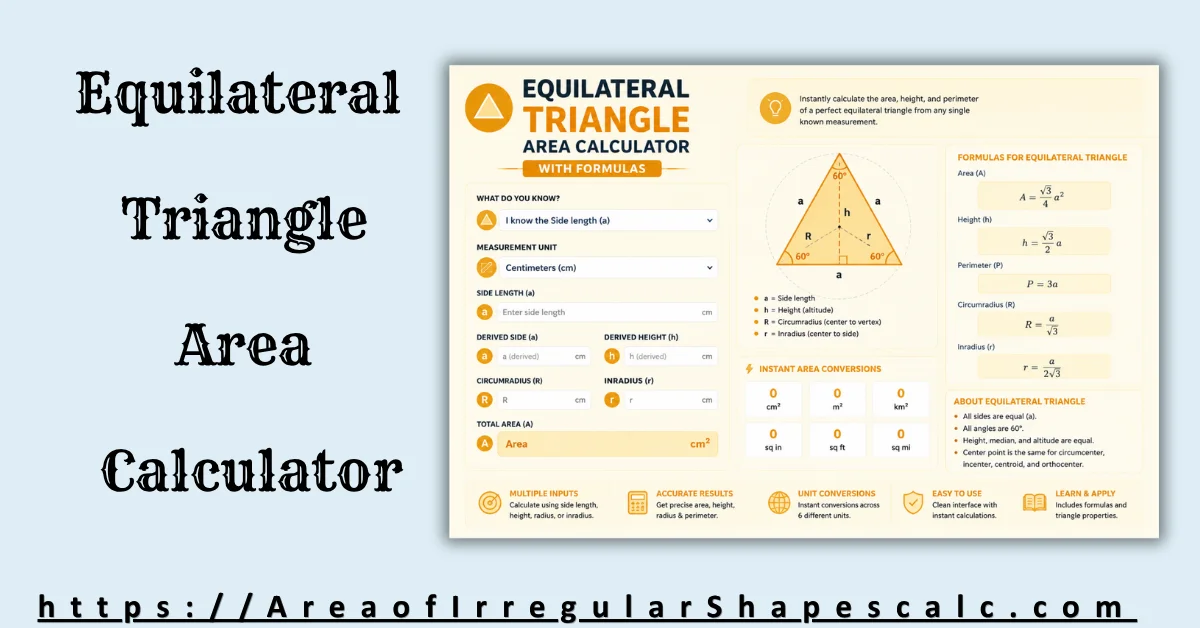
One major advantage of the calculator is speed. Manual calculations usually require several separate formulas and careful unit handling. The calculator performs these instantly and reduces the chances of human error, especially when working with decimal values or large measurements.
Because all sides are equal, even a small amount of information is enough to solve the entire triangle accurately.
Formulas Used in an Equal Triangle Area Calculator
Although the calculator automates the process, understanding the formulas behind it helps explain how all measurements are connected.
Area Formula of an Equilateral Triangle
The most common formula used to calculate area is:
\(A = \frac{\sqrt{3}}{4}a^2\)
Where:
-
\(A\)= area -
\(a\)= side length
This formula works because an equilateral triangle can be divided into two identical right triangles. Once divided, trigonometric relationships create the \(\sqrt{3}\) component inside the equation.
For example, if the side length is 10 cm:
\(A = \frac{\sqrt{3}}{4}(10)^2\)
\(A \approx 43.3 \text{ cm}^2\)
The calculator performs this instantly while also calculating all related dimensions automatically.
Height Formula
The height of an equilateral triangle is calculated using:
\(h = \frac{\sqrt{3}}{2}a\)
The height creates a perpendicular line from the top vertex to the center of the base. This line divides the equilateral triangle into two 30-60-90 right triangles.
If the side length is 10 cm:
\(h = \frac{\sqrt{3}}{2}(10)\)
\(h \approx 8.66 \text{ cm}\)
In real construction layouts, this height measurement becomes important when determining roof slopes, triangular supports, or centered framework spacing.
Perimeter Formula
Since all three sides are equal, the perimeter formula is straightforward:
\(P = 3a\)
If one side measures 10 cm:
\(P = 3(10)\)
\(P = 30 \text{ cm}\)
The calculator uses this relationship to instantly derive the total boundary length of the triangle.
Circumradius Formula
The circumradius represents the radius of the circle surrounding the triangle and touching all three vertices.
The formula is:
\(R = \frac{a}{\sqrt{3}}\)
This value becomes useful in geometric design, CAD modeling, navigation geometry, and circular layouts involving triangular symmetry.
Inradius Formula
The inradius measures the radius of the circle perfectly fitted inside the triangle.
The formula is:
\(r = \frac{a\sqrt{3}}{6}\)
This calculation is commonly used in engineering diagrams, structural spacing, and geometric optimization problems.
Why the Equal Triangle Formula Contains √3
Many users wonder why the area and height formulas contain \(\sqrt{3}\).
The reason comes from trigonometry and the special properties of a 30-60-90 triangle.
When the altitude of an equilateral triangle is drawn, the triangle splits into two identical right triangles. Each right triangle contains:
-
a 30-degree angle,
-
a 60-degree angle,
-
a hypotenuse equal to the original side length.
Using trigonometric ratios, the height becomes:
\(h = \frac{\sqrt{3}}{2}a\)
This height formula is then substituted into the standard triangle area equation:
\(A = \frac{1}{2}bh\)
Since the base and side are equal in an equilateral triangle, the simplified result becomes:
\(A = \frac{\sqrt{3}}{4}a^2\)
This geometric relationship is one reason equilateral triangles are considered mathematically elegant and highly predictable.
How to Use the Equal Triangle Area Calculator
The calculator is designed to simplify geometry calculations while reducing manual work.
Enter the Known Measurement
Start by selecting the value you already know. Most users enter the side length, but some calculators may also allow height, perimeter, area, or radius inputs.
Because every dimension inside an equilateral triangle is connected, a single measurement is enough to solve the remaining properties.
Select the Measurement Unit
Choose the desired unit before calculation. Common options include:
-
centimeters,
-
meters,
-
inches,
-
feet,
-
kilometers.
Consistent units are important because area values are always squared measurements.
For example:
-
cm becomes cm²,
-
m becomes m²,
-
ft becomes ft².
View Automatically Derived Values
After entering the value, the calculator instantly computes:
-
area,
-
height,
-
perimeter,
-
inradius,
-
circumradius.
This saves time compared to manually applying multiple equations separately.
Use Instant Area Conversions
Modern calculators often include automatic conversion tools. This allows users to switch between square centimeters, square meters, square feet, square miles, and other units without recalculating the triangle manually.
This feature becomes especially useful in architecture, land measurement, engineering planning, and international projects where multiple unit systems may be required.
Why Equilateral Triangles Are Geometrically Special
Equilateral triangles occupy a unique place in geometry because they combine perfect symmetry with structural stability.
Every side has equal length, every angle measures 60 degrees, and every internal line follows predictable mathematical relationships. Because of this, equilateral triangles are often used in mathematical proofs, trigonometry, structural engineering, and geometric optimization.
Their balanced shape also distributes force evenly. In real-world engineering, this property helps create stable frameworks and support systems. Bridge trusses, roof supports, and triangular reinforcement systems often rely on triangular geometry because triangles resist deformation better than many other polygon shapes.
Equilateral triangles also appear frequently in tessellation patterns, navigation systems, computer graphics, and architectural design because their repeating geometry creates efficient and visually balanced layouts.
Meanwhile, in mathematics education, equilateral triangles help students understand:
-
symmetry,
-
angle relationships,
-
trigonometric ratios,
-
area derivation,
-
geometric transformations.
Because of their simplicity and predictability, they are commonly introduced early in geometry courses.
Real-World Applications of Equal Triangle Calculations
Although equilateral triangles are commonly studied in classrooms, their practical applications extend far beyond education.
In architecture, triangular frameworks are frequently used to distribute structural loads evenly. Roof trusses often contain equilateral or nearly equilateral sections because balanced geometry improves stability while reducing material stress.
Surveyors and land planners may also encounter triangular layouts when dividing plots, marking boundaries, or creating measurement grids. Since equal-sided triangles simplify distance calculations, they can help improve accuracy in field measurements.
In engineering, equilateral triangle calculations appear in bridge supports, mechanical structures, tower bracing systems, and load distribution analysis. The symmetry of the shape helps engineers predict force behavior more efficiently.
Graphic designers and digital artists also use equilateral triangles in geometric patterns, logos, 3D modeling, and tessellation-based designs. Because the shape remains visually balanced from every direction, it creates clean and stable visual compositions.
Meanwhile, in agriculture and mapping projects, triangular spacing systems may be used for planting layouts, irrigation planning, and positioning calculations where equal spacing improves organization and measurement consistency.
Common Mistakes When Calculating Equal Triangle Area
Even though equilateral triangles are simpler than irregular triangles, calculation mistakes still happen frequently.
Confusing Height With Side Length
One of the most common mistakes is treating the height as equal to the side length. In an equilateral triangle, the height is always shorter than the side because it follows:
\(h = \frac{\sqrt{3}}{2}a\)
Using the wrong value can significantly distort the final area result.
Forgetting Square Units
Area measurements must always use square units.
For example:
-
cm² instead of cm,
-
m² instead of m,
-
ft² instead of ft.
This error commonly appears in homework calculations and practical measurement reports.
Using Incorrect Unit Conversions
Switching between metric and imperial systems without proper conversion can create inaccurate results. A reliable calculator helps prevent this by automatically converting values consistently.
Rounding Too Early
Rounding intermediate values too soon may slightly distort the final answer, especially in engineering or construction calculations where precision matters.
Using full decimal precision until the final step produces more accurate results.
Equal Triangle vs Other Triangle Types
An equilateral triangle differs significantly from other triangle categories.
In a scalene triangle, all sides and angles are different. This makes formulas more complicated because additional measurements are usually required.
An isosceles triangle contains only two equal sides, meaning some symmetry exists, but not to the same extent as an equilateral triangle.
Right triangles focus primarily on perpendicular relationships and the Pythagorean theorem, while equilateral triangles emphasize symmetry and consistent angular geometry.
Because equilateral triangles are fully symmetrical, they allow faster calculations and more predictable geometric behavior than most other triangle forms.
FAQs
Is an equal triangle the same as an equilateral triangle?
Yes. The term “equal triangle” commonly refers to an equilateral triangle because all three sides are equal in length.
Can you calculate an equilateral triangle using only one side?
Yes. Since all geometric relationships inside the triangle are connected, one side measurement is enough to calculate area, height, perimeter, inradius, and circumradius.
Why is the area formula different from a regular triangle formula?
A standard triangle formula uses base and height separately. In an equilateral triangle, the height can be derived directly from the side length, allowing the formula to simplify into:
\(A = \frac{\sqrt{3}}{4}a^2\)
How do you find the height of an equilateral triangle?
The height formula is:
\(h = \frac{\sqrt{3}}{2}a\)
Where \(a\) represents the side length.
What is the difference between circumradius and inradius?
The circumradius measures the radius of the outer circle surrounding the triangle, while the inradius measures the radius of the circle fitted inside the triangle.
Can the calculator convert area units automatically?
Yes. Many advanced calculators instantly convert area values between metric and imperial systems, including square centimeters, square meters, square feet, and square miles.
Where are equilateral triangles used in real life?
Equilateral triangles are used in engineering frameworks, bridge supports, roof trusses, surveying systems, geometric design, mapping layouts, and computer graphics.
Final Thoughts
An equal triangle area calculator simplifies one of geometry’s most symmetrical shapes by automatically solving multiple dimensions from a single known value. Since every side and angle in an equilateral triangle follows predictable mathematical relationships, the calculator can quickly determine area, height, perimeter, inradius, circumradius, and unit conversions with high accuracy.
Beyond classroom geometry, these calculations play an important role in architecture, engineering, surveying, construction planning, and geometric design. Manual calculations can become repetitive and error-prone, especially when converting units or working with decimal measurements. A dedicated calculator helps streamline the process while improving precision and efficiency.
Because equilateral triangles are built on perfect symmetry, they remain one of the clearest examples of how geometry, trigonometry, and practical measurement work together in both mathematics and real-world applications.