Advanced Specialty Triangles Calculator
Calculate the area for complex non-Euclidean shapes, including Spherical Triangles (using Girard's Theorem) and Fractal Sierpinski Triangles.
For a Spherical Triangle, the sum of all three angles must be strictly greater than 180° and less than 540°.
Instant Area Conversions
Most people learn triangle geometry using flat surfaces where the angles of a triangle always add up to 180 degrees. This traditional system is known as Euclidean geometry and works perfectly for ordinary triangles drawn on paper or measured on flat land. However, not all triangles exist on flat surfaces, and not all geometric patterns behave in simple linear ways.
Spherical triangles and Sierpinski triangles belong to a more advanced category of geometry often called specialty triangle mathematics. These shapes behave very differently from standard triangles because they involve curved surfaces, recursive structures, and nontraditional geometric rules.
A spherical triangle exists on the surface of a sphere rather than a flat plane. Instead of straight lines, its boundaries follow curved paths called great circles. Because the surface itself curves outward, the interior angles of a spherical triangle can exceed 180 degrees. This type of geometry becomes extremely important in Earth navigation, astronomy, satellite systems, and global mapping.
Meanwhile, a Sierpinski triangle belongs to fractal geometry. Instead of existing as a single static shape, it repeats itself recursively through smaller triangular patterns. Each stage creates increasingly detailed geometric structures while preserving the same overall pattern. This recursive behavior makes the Sierpinski triangle important in computer graphics, mathematical modeling, signal systems, and fractal research.
Because these topics involve more advanced mathematics, a specialized calculator becomes extremely useful for simplifying calculations and visualizing relationships that would otherwise require lengthy manual solving.
What the Spherical & Sierpinski Triangle Calculator Solves
A Spherical & Sierpinski Triangle Calculator is designed to solve advanced triangle geometry that goes beyond ordinary flat-surface calculations. Instead of focusing only on basic area formulas, the calculator handles curved-space geometry and recursive fractal relationships automatically.
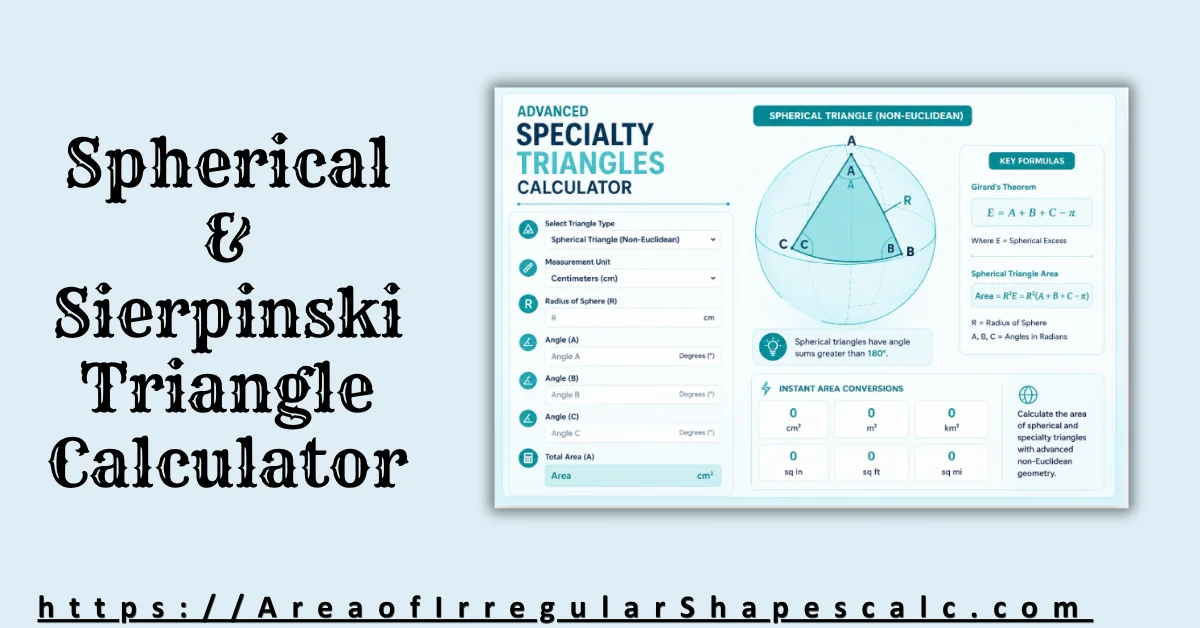
For spherical triangles, the calculator can determine area using sphere radius and angular measurements. It applies Girard’s Theorem to calculate spherical excess and convert angular geometry into measurable surface area. Since these calculations involve curved geometry rather than standard Euclidean rules, solving them manually can quickly become difficult.
For Sierpinski triangles, the calculator can analyze recursive fractal behavior by determining area reduction patterns across multiple iterations. Because each recursive stage subdivides the triangle repeatedly, manual calculations become increasingly repetitive as complexity grows.
This makes the tool useful not only for students learning advanced mathematics, but also for researchers, engineers, GIS specialists, astronomy learners, and anyone exploring non-Euclidean or fractal geometry.
Understanding Spherical Triangles
A spherical triangle is a triangle drawn on the surface of a sphere rather than on a flat plane. Instead of straight edges, the triangle is formed using curved arcs called great circles, which represent the largest possible circles that can exist on a sphere.
Earth itself provides one of the easiest examples of spherical geometry. Lines of longitude behave like great circles, and when navigation routes are plotted across the globe, they naturally form curved geometric paths rather than flat triangles.
Because spherical surfaces curve outward, spherical triangles behave differently from ordinary triangles. In Euclidean geometry, the sum of a triangle’s interior angles always equals 180 degrees. In spherical geometry, however, the total angle sum exceeds 180 degrees. This additional amount is called spherical excess.
The larger the triangle becomes on the sphere’s surface, the greater the spherical excess becomes. Very small spherical triangles may behave almost like ordinary triangles, but larger ones clearly demonstrate non-Euclidean geometry.
This unusual angle behavior is one reason spherical geometry plays such an important role in global navigation, aviation systems, astronomy, and geodesic calculations.
Girard’s Theorem and Spherical Triangle Area
The most important formula used in spherical triangle calculations is Girard’s Theorem.
The formula is:
\(A = R^2(E)\)
Where:
-
\(A\)= spherical triangle area -
\(R\)= radius of the sphere -
\(E\)= spherical excess
The spherical excess formula is:
\(E = A + B + C - \pi\)
In this equation, the three angles of the spherical triangle are added together, and then 180 degrees (or \(\pi\) radians) is subtracted to determine the excess angle.
This excess directly determines the triangle’s area on the curved surface.
For example, suppose a spherical triangle on Earth contains angle measurements whose total equals 210 degrees. The spherical excess becomes:
\(210^\circ - 180^\circ = 30^\circ\)
That excess is then converted into area using the sphere’s radius.
Unlike ordinary geometry, spherical triangle area depends heavily on the curvature of the surface itself. Because of this, the same angle measurements may produce different areas on spheres of different sizes.
This relationship is extremely important in geodesy, astronomy, GPS systems, and Earth-surface calculations.
Why Spherical Geometry Differs From Flat Geometry
The key difference between spherical geometry and ordinary geometry is curvature.
Flat geometry assumes that space remains perfectly level in every direction. On curved surfaces, however, shortest paths behave differently. Instead of straight lines, movement follows geodesic curves across the sphere.
This becomes obvious in aviation navigation. Airplanes traveling long distances rarely move in perfectly straight paths on flat maps. Instead, they follow curved great-circle routes because these paths represent the shortest distance across Earth’s curved surface.
Similarly, satellite systems and GPS calculations rely on spherical geometry because Earth is not flat. Standard Euclidean geometry alone cannot accurately model large-scale navigation over curved planetary surfaces.
Another major difference involves angle behavior. In ordinary triangles, angle sums remain fixed at 180 degrees. Spherical triangles exceed this value because curved surfaces distort geometric relationships.
These differences make spherical geometry one of the most important branches of non-Euclidean mathematics.
Understanding the Sierpinski Triangle
The Sierpinski triangle is one of the most famous fractals in mathematics. Unlike ordinary geometric figures, it is built through recursive repetition where the same triangular pattern appears repeatedly at smaller and smaller scales.
The structure begins with a single triangle. The central inverted triangle is removed, leaving three smaller triangles behind. The same process is then repeated inside each remaining triangle indefinitely.
As the recursion continues, increasingly complex patterns emerge while preserving the same overall geometric structure. This property is known as self-similarity because every section resembles the larger figure.
What makes the Sierpinski triangle especially fascinating is that its area continuously decreases while its perimeter becomes increasingly complex. This creates unusual mathematical behavior that does not appear in ordinary geometry.
Because the pattern can theoretically continue forever, the Sierpinski triangle is considered an infinite fractal object.
Recursive Area Reduction in a Sierpinski Triangle
Each recursive stage removes additional triangular sections from the original shape.
The recursive area formula is commonly represented as:
\(A_n = A_0\left(\frac{3}{4}\right)^n\)
Where:
-
\(A_n\)= area after iteration\(n\) -
\(A_0\)= original triangle area
This formula shows that each iteration preserves only three-fourths of the previous area.
For example, if the original triangle area equals 100 square units:
After the first iteration:
\(100\left(\frac{3}{4}\right) = 75\)
After the second iteration:
\(75\left(\frac{3}{4}\right) = 56.25\)
As recursion continues, the remaining area gradually decreases toward zero while the geometric complexity continues increasing.
This recursive behavior makes the Sierpinski triangle important in computational geometry, digital graphics, signal systems, and fractal modeling.
How to Use the Spherical & Sierpinski Triangle Calculator
The calculator is designed to simplify advanced geometry calculations that would otherwise require lengthy manual solving.
To begin, select the desired triangle type. Depending on the calculator interface, this may involve choosing either spherical geometry or Sierpinski fractal calculations.
For spherical triangles, enter the sphere radius along with the required angle measurements. The calculator automatically computes spherical excess and converts the curved geometry into measurable surface area.
For Sierpinski calculations, enter the starting triangle dimensions along with the desired recursion level. The calculator then determines how the area changes across successive iterations.
Most advanced calculators also support automatic conversions between multiple measurement systems, which becomes useful in scientific and engineering applications.
Because these calculations involve recursive structures and non-Euclidean formulas, calculators greatly improve both speed and reliability.
Real-World Applications of Spherical and Fractal Triangles
Although these concepts may initially appear theoretical, both spherical and fractal triangles have important real-world applications.
Spherical geometry plays a critical role in navigation and mapping because Earth itself is spherical. Airline flight paths, GPS systems, satellite positioning, and geodesic surveying all depend on curved-surface calculations rather than flat geometry.
Astronomy also relies heavily on spherical triangles when measuring celestial coordinates, planetary movement, and spatial relationships across curved observation systems.
Meanwhile, Sierpinski triangles and fractal geometry appear in computer graphics, procedural generation, image compression, and digital modeling systems. Fractal structures are especially useful because they create highly detailed patterns using relatively simple recursive rules.
Engineers also use fractal geometry in antenna design because recursive patterns can improve signal behavior while reducing physical size. Similar concepts appear in network modeling, natural pattern analysis, and computational simulations.
Even nature itself displays fractal-like structures in coastlines, snowflakes, plant growth, and branching systems where repeating patterns emerge across different scales.
Common Mistakes When Calculating Specialty Triangles
Advanced triangle geometry introduces several common calculation mistakes, especially for users unfamiliar with non-Euclidean mathematics.
One major issue involves confusing degrees and radians. Spherical geometry formulas often require angle conversion before calculations can be performed correctly.
Another common mistake occurs when users assume ordinary Euclidean rules still apply. In spherical geometry, triangle angles can exceed 180 degrees, which often surprises beginners.
For Sierpinski triangles, recursion level confusion may lead to incorrect area calculations because each iteration changes the structure repeatedly.
Users may also misunderstand self-similarity by assuming each recursive layer behaves independently, when in reality the entire structure remains mathematically connected.
Premature rounding can also reduce accuracy, especially during recursive calculations involving many iterations.
Because of these complexities, advanced geometry calculators significantly reduce calculation errors while improving conceptual understanding.
Spherical & Sierpinski Triangle Calculator vs Manual Calculation
Manual calculations for specialty triangles can become extremely difficult because they involve advanced geometry concepts that differ from ordinary mathematical rules.
Spherical triangle calculations require handling curved surfaces, spherical excess, angle conversions, and non-Euclidean relationships. Meanwhile, Sierpinski triangles involve recursive scaling and iterative area reduction across potentially large recursion levels.
A specialized calculator simplifies this process by automatically applying the correct formulas while handling conversions and recursion instantly.
Instead of manually performing multiple recursive calculations or non-Euclidean conversions, the calculator solves everything from a single interface.
FAQs
What is a spherical triangle?
A spherical triangle is a triangle drawn on the surface of a sphere using curved great-circle boundaries instead of straight lines.
Why do spherical triangle angles exceed 180°?
Because the surface is curved, spherical geometry behaves differently from flat Euclidean geometry, causing the angle sum to exceed 180 degrees.
What is Girard’s Theorem?
Girard’s Theorem calculates the area of a spherical triangle using spherical excess and sphere radius.
What is a Sierpinski triangle?
A Sierpinski triangle is a recursive fractal formed by repeatedly removing smaller triangles from a larger triangle.
Why is the Sierpinski triangle considered a fractal?
It is considered a fractal because the same geometric pattern repeats recursively at smaller and smaller scales.
Where is spherical geometry used in real life?
Spherical geometry is used in GPS systems, aviation navigation, astronomy, geodesic surveying, and Earth mapping.
What are fractal triangles used for?
Fractal triangles are used in computer graphics, antenna design, mathematical modeling, image compression, and procedural generation systems.
Final Thoughts
A Spherical & Sierpinski Triangle Calculator simplifies advanced geometry by combining non-Euclidean mathematics and recursive fractal calculations into a single tool. Whether solving spherical triangle area using Girard’s Theorem or exploring recursive Sierpinski fractal behavior, the calculator makes highly specialized geometry far more understandable and accessible.
These concepts play an important role in navigation systems, astronomy, computational modeling, engineering research, and digital graphics because many real-world systems rely on curved surfaces and recursive structures rather than ordinary flat geometry. Manual calculations can quickly become complex when spherical excess, recursion levels, and advanced formulas are involved.
By automating advanced formulas, recursive calculations, and unit conversions, the calculator improves both accuracy and efficiency while helping users better understand some of mathematics’ most fascinating geometric systems.