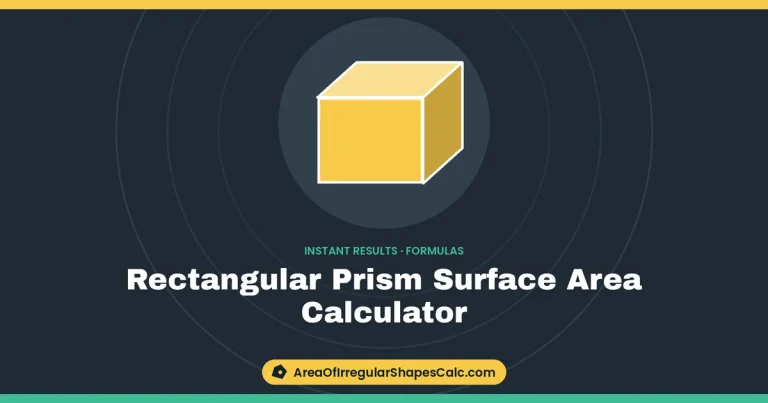
A flat rectangle has an area and a perimeter, while a three-dimensional rectangle, a box, has a surface area. This rectangle surface area calculator handles both: a flat mode that returns area and perimeter from length and width, and a box mode that returns the total surface area of a rectangular prism.
Rectangle Surface Area Calculator
Area of a flat rectangle, or surface area of a 3D rectangle (rectangular prism).
The starting flat rectangle is 8 × 5 cm, which has an area of 40 cm² and a perimeter of 26 cm. The starting box is 8 × 5 × 4 cm, which has a surface area of 184 cm².
How is the surface area of a rectangle calculated?
In flat mode the calculator multiplies length by width for the area and doubles their sum for the perimeter. In box mode it adds the areas of the three pairs of faces.
Area = Length × Width
Perimeter = 2 × (Length + Width)
Surface area of a box = 2 × (Length × Width + Length × Height + Width × Height)
Worked example: the starting values
Flat: Area = 8 × 5 = 40 cm²
Flat: Perimeter = 2 × (8 + 5) = 26 cm
Box: 8 × 5 = 40, 8 × 4 = 32, 5 × 4 = 20
Sum = 40 + 32 + 20 = 92
Surface area = 2 × 92 = 184 cm²
The 40 is the top, which is matched by the bottom. The 32 is the front and back, and the 20 is the two ends. A flat rectangle has no surface area in the 3D sense, so the box mode is the one to use for a solid.
Worked examples for different boxes
Worked examples
A box with no lid
An open-topped box such as an aquarium has no top face. Take the top area of 8 × 5 = 40 away from the total, so 184 − 40 = 144 cm².
What the calculator leaves out
It treats the box as a closed solid with square corners, so it does not remove a lid or add overlap for seams. It does not give volume or a separate lateral area. All three dimensions must use the same unit, and the result is in that unit squared. Because the flat mode has only area and perimeter, a rectangle drawn on paper never has a surface area apart from its area.
Box sizes compared
The table shows the surface area of four boxes next to the area and perimeter of their flat base.
| Box | Surface area | Base area | Base perimeter |
|---|---|---|---|
| 8 × 5 × 4 cm | 184 cm² | 40 cm² | 26 cm |
| 10 × 10 × 10 cm | 600 cm² | 100 cm² | 40 cm |
| 12 × 8 × 6 cm | 432 cm² | 96 cm² | 40 cm |
| 20 × 10 × 5 cm | 700 cm² | 200 cm² | 60 cm |
Doubling every dimension of the starting box, from 8 × 5 × 4 to 16 × 10 × 8 cm, multiplies the surface area by four, from 184 to 736 cm².
Painting or wrapping a box
The surface area tells you how much material covers the outside. For a box that sits on a floor or a shelf, the bottom face may not need covering, so subtract it. Add an allowance for seams and overlap that depends on the material, and keep every dimension in one unit. The starting box is 184 cm², which is 0.0184 m² or 28.52 in².
Write down every measurement together with its unit before you start, and check the result against a quick mental estimate so that a slip in a unit or a decimal point is caught early.
Frequently asked questions
What is the surface area of a rectangle?
A flat rectangle has an area, length times width. Surface area applies to a box, where it is 2(lw + lh + wh). The starting box gives 184 cm².
How do I find the surface area of a box with no lid?
Subtract the area of the missing face. Without a top, the starting box is 184 − 40 = 144 cm².
How do I find the lateral area of a rectangular prism?
Multiply the base perimeter by the height. The starting box gives 2 × (8 + 5) × 4 = 104 cm².
What is the perimeter of a rectangle?
2 × (length + width). The starting 8 × 5 cm rectangle has a perimeter of 26 cm.
What unit is the answer in?
The square of the unit you enter. Centimetres give square centimetres.