
Irregular Hexagon Area Calculator
Three ways to calculate a hexagon’s area: from the X/Y coordinates of its six corners (most accurate, recommended), from six side lengths plus the three diagonals measured from one corner (for land plots and roofs measured by tape), or a quick closed-form calculation for a regular (equal-sided) hexagon.
Enter the X and Y coordinate of each corner, in order around the shape (from a survey plan, CAD drawing, or map). Works for both convex and concave (non-symmetrical) hexagons.
| Point | X | Y |
|---|---|---|
| 1 | ||
| 2 | ||
| 3 | ||
| 4 | ||
| 5 | ||
| 6 |
Six side lengths alone cannot fix the area of an irregular hexagon — the shape can still flex. Also measure the three diagonals running from one corner (Vertex 1) to the three corners that are not next to it. This is the same “triangulation from one corner” technique used to survey irregular land plots.
Sides (in order around the hexagon)
Diagonals from Vertex 1
For a regular hexagon (six equal sides, six 120° angles), enter any one known measurement and every other value is calculated instantly.
Six-sided shapes show up in real life more often than we realize. A land boundary bends around a road. A roof footprint changes direction to fit the structure.
A floor plan grows unevenly as rooms are added over time. On paper, these shapes may still look like hexagons, but they no longer follow neat rules.
Once a hexagon loses equal sides and angles, simple formulas stop working. Guessing the area becomes risky, especially when the numbers matter.
That is where this Irregular Hexagon Area Calculator helps. It does not rely on assumptions. It works directly from coordinates, using a proven method trusted in real-world measurement.
The calculator on this page supports three input methods: entering the coordinates of each corner (the most accurate option), entering six side lengths plus three diagonals measured from one corner (useful when a shape is measured by tape on site), and a quick calculation for a regular hexagon when all sides and angles are equal. Whichever method you use, the tool also reports the interior angle at every corner and the point-to-point and flat-to-flat diameters of the shape.
What Is an Irregular Hexagon?
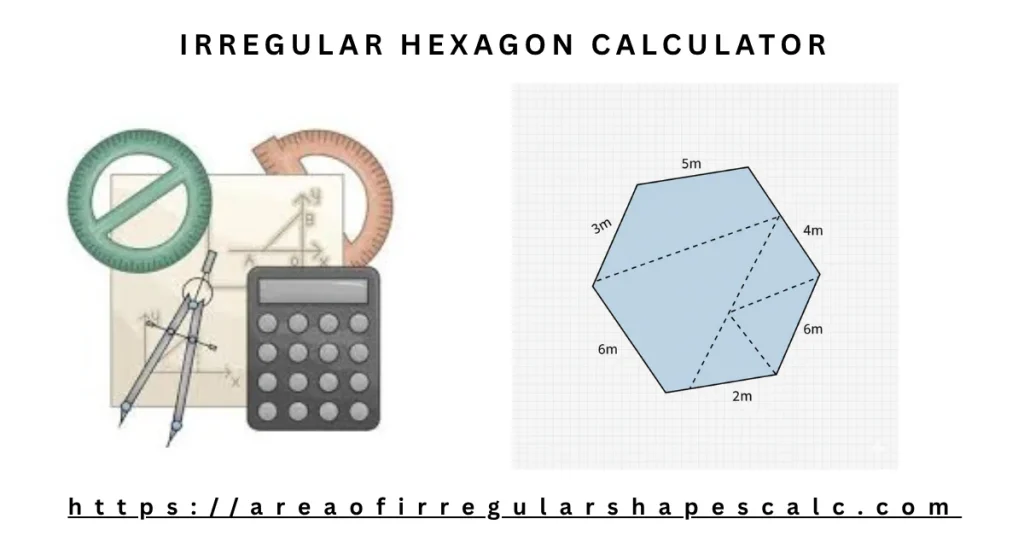
A hexagon is any shape with six sides.
It becomes irregular when:
- The sides are not the same length
- The angles are different
- The shape is not symmetrical
Most hexagons found in land, buildings, and layouts fall into this category. Once symmetry is gone, there is no shortcut formula that can calculate the area from side lengths alone.
Why Irregular Hexagons Are Difficult to Calculate
Irregular hexagons introduce more uncertainty than smaller shapes.
- There are many possible diagonals, each with a different length
- The shape may bend inward or outward
- Side measurements alone do not fully define the area
Breaking the shape into triangles often leads to different answers depending on how it is split. Coordinates solve this problem by fixing the exact position of every corner.
The Most Reliable Solution: Using Coordinates
This calculator uses the shoelace method, also known as the Gauss method.
You do not need to understand the formula to use it, but the idea is simple. The calculator takes the X and Y coordinates of each corner, in order around the shape, and calculates the area from those points.
This approach:
- Works for both convex and concave shapes
- Is not affected by orientation or rotation
- Produces exact results for straight-edged polygons
That is why coordinates are used in surveying, mapping software, CAD tools, and GIS systems.
How to Use the Irregular Hexagon Area Calculator
Using the calculator is straightforward.
- Pick a tab: Coordinates, Sides & Diagonals, or Regular Hexagon
- Choose your measurement unit
- Enter the X and Y coordinates for all six corners, in order (or the sides and diagonals, or a single regular-hexagon measurement, depending on the tab)
- Click calculate
The calculator processes your inputs and displays the total area, the interior angles, and the diameters in your chosen unit. You do not need to handle formulas or conversions manually.
Sides and Diagonals: An Alternative When You Cannot Get Coordinates
Six side lengths on their own do not fix the area of an irregular hexagon — the shape can still flex like a hinge while every side stays the same length. To lock the shape down, the Sides & Diagonals tab also asks for the three diagonals measured from one corner (Vertex 1) to the three corners that are not next to it. This splits the hexagon into four triangles, each solved with Heron’s formula, which is the same triangulation technique used to survey irregular land plots by tape.
Regular Hexagon: A Quick Calculation When All Sides Are Equal
If the hexagon is regular — six equal sides and six 120° angles — there is no need for coordinates or diagonals. The Regular Hexagon tab calculates the area, perimeter, and both diameters from any single known measurement: the side length, the perimeter, the point-to-point diameter, or the flat-to-flat diameter.
Where This Calculator Is Commonly Used
Land and Plot Measurement
Property boundaries often curve around roads, rivers, or nearby plots, creating six-sided shapes that are far from regular. Using coordinates from survey data or maps gives an accurate and defensible area.
Roof Footprints and Structural Layouts
Roof designs frequently intersect at multiple angles, forming irregular hexagons. Accurate area calculation helps with material estimates and planning.
Floor Plans and Building Design
As buildings are expanded or renovated, floor layouts may evolve into six-sided shapes. Coordinates from drawings allow precise calculation of usable space.
Mapping and GIS Work
In mapping systems, regions are defined by points, not side lengths. This calculator follows the same logic, making it suitable for technical and professional workflows.
Engineering and Design Analysis
In constrained designs, boundaries often form irregular hexagons. Coordinate-based area calculation keeps results consistent across planning and execution.
Common Mistakes to Watch For
To get accurate results, avoid these issues:
- Entering points out of order
- Allowing edges to cross over each other
- Mixing coordinate units
- Assuming the shape is convex when it is not
Careful input prevents these problems and ensures reliable output.
When Should You Use This Calculator?
This calculator is the right choice when:
- The shape has exactly six sides
- You know the coordinates of each corner, or the six sides plus three diagonals from one corner
- Accuracy is more important than approximation
If you have side lengths but no diagonals and no coordinates, the shape is not fully defined — measure the three diagonals from one corner (Sides & Diagonals tab) or use coordinates instead. For a different number of sides, a pentagon or quadrilateral calculator is more suitable, and for freehand sketches, a draw or image-based tool works better.
Frequently Asked Questions
Can I calculate the area of an irregular hexagon from its six side lengths alone?
Not on their own. Six side lengths can be rearranged into many different hexagon shapes with different areas, because the shape can still flex at each corner like a hinge. To get one exact area, you also need either the coordinates of each corner or the three diagonals measured from one corner. Use the Sides & Diagonals tab if you have tape measurements, or the Coordinates tab if you have a survey plan or drawing.
How do I find the diameter of a hexagon?
A hexagon has two commonly used diameters: the point-to-point diameter, measured across two opposite corners, and the flat-to-flat diameter, measured across two opposite sides. For a regular hexagon, enter any one known measurement into the Regular Hexagon tab and both diameters are calculated automatically. For an irregular hexagon, use the Coordinates or Sides & Diagonals tab and the calculator reports the longest diagonal alongside the area.
Does this calculator work for a regular hexagon too?
Yes. Use the Regular Hexagon tab and enter any single known value — side length, perimeter, or either diameter — to instantly get the area, perimeter, and both diameters. You can also enter a regular hexagon’s coordinates into the Coordinates tab if you already have them; the result will match the closed-form calculation.
What do a hexagon’s interior angles add up to, and does the calculator show them?
The interior angles of any hexagon, regular or irregular, always add up to 720°. In a regular hexagon each angle is exactly 120°; in an irregular hexagon the angles vary, and one or more can be a reflex angle (greater than 180°) if the shape is concave. The Coordinates and Sides & Diagonals tabs both calculate and display the interior angle at every corner alongside the area.
Final Thoughts
Irregular hexagons reflect real-world constraints, not perfect geometry.
By describing the shape exactly as it exists, point by point, this calculator removes guesswork and delivers results you can trust. When precision matters, coordinates are the safest way to calculate area.