Acute Triangle Area Calculator
Calculate the area of any acute triangle. Features a built-in Acute Validator to mathematically prove if your triangle is truly acute.
These side lengths cannot form a closed triangle. The sum of any two sides must be strictly greater than the third side.
Instant Area Conversions
An acute triangle is a triangle in which all three interior angles are less than 90 degrees. Unlike right triangles that contain one exact 90-degree angle or obtuse triangles that contain one angle greater than 90 degrees, acute triangles remain completely “sharp” in appearance because every angle stays below a right angle.
This geometric property creates a balanced triangular structure that appears frequently in mathematics, architecture, engineering, construction systems, and structural design. Acute triangles may exist in different forms depending on their side lengths. Some acute triangles are perfectly symmetrical, while others contain completely unequal sides and angles.
For example, an equilateral triangle is always acute because all three interior angles equal 60 degrees. However, many scalene triangles also qualify as acute triangles as long as every angle remains below 90 degrees.
Because triangle measurements are often irregular in practical situations, determining whether a triangle is truly acute can sometimes become difficult. This is where an Acute Triangle Area Calculator becomes extremely useful.
Instead of manually checking angle relationships and solving formulas separately, the calculator can automatically validate the triangle type while simultaneously calculating area, perimeter, and related measurements using multiple geometry methods.
What the Acute Triangle Area Calculator Solves
An Acute Triangle Area Calculator is designed to calculate the area of acute triangles while also verifying whether the triangle satisfies acute-angle conditions mathematically.
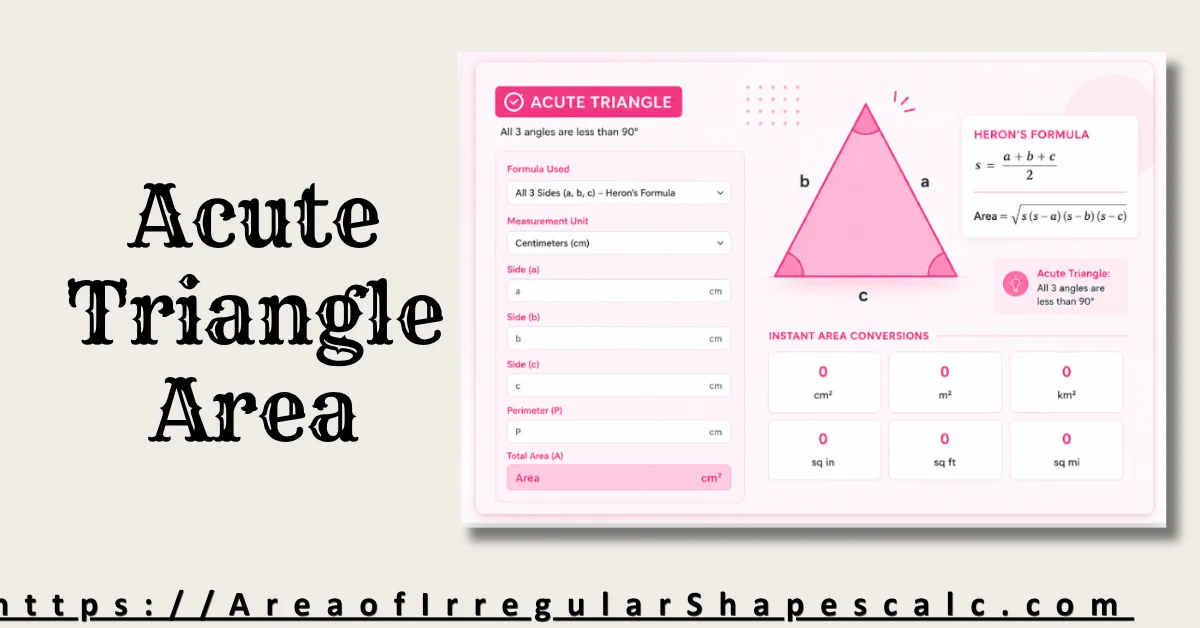
This becomes especially useful because not every set of triangle sides forms an acute triangle. Some side combinations create right triangles or obtuse triangles instead. Reliable calculators automatically validate the geometry before producing the final result.
The calculator also reduces common manual calculation mistakes involving:
-
incorrect semiperimeter calculations,
-
invalid side combinations,
-
incorrect height usage,
-
unit inconsistencies,
-
formula selection errors.
Because acute triangle calculations often involve both geometry classification and area solving together, calculators provide much faster and more reliable results than manual calculations alone.
Formulas Used in an Acute Triangle Area Calculator
Several formulas may be used depending on the information available about the triangle.
Base and Height Formula
When the perpendicular height is known directly, the standard triangle area formula becomes the simplest solving method.
The formula is:
\(A = \frac{1}{2}bh\)
Where:
-
\(A\)= area -
\(b\)= base -
\(h\)= perpendicular height
For example, if an acute triangle has a base of 12 centimeters and a height of 9 centimeters:
\(A = \frac{1}{2}(12)(9)\)
\(A = 54 \text{ cm}^2\)
Although this formula is straightforward, practical measurements often do not provide the perpendicular height directly. In those situations, Heron’s Formula becomes much more useful.
Heron’s Formula
Heron’s Formula calculates triangle area using only the three side lengths.
The formula is:
\(A = \sqrt{s(s-a)(s-b)(s-c)}\)
Where:
-
\(a\),\(b\),\(c\)= side lengths -
\(s\)= semiperimeter
This formula is especially important for acute triangles because many irregular acute triangles do not provide measurable heights directly.
Semi-Perimeter Formula
Before applying Heron’s Formula, the semiperimeter must be calculated.
The formula is:
\(s = \frac{a+b+c}{2}\)
Suppose the triangle sides measure:
-
7 m,
-
8 m,
-
9 m.
First calculate semiperimeter:
\(s = \frac{7+8+9}{2}\)
\(s = 12\)
Then apply Heron’s Formula:
\(A = \sqrt{12(12-7)(12-8)(12-9)}\)
\(A = \sqrt{12(5)(4)(3)}\)
\(A \approx 26.83 \text{ m}^2\)
The calculator performs these calculations instantly while also verifying whether the triangle remains acute.
How to Determine if a Triangle Is Acute
One of the most important features of an Acute Triangle Area Calculator is automatic triangle validation.
A triangle is considered acute only if all three angles remain below 90 degrees. While this can be checked directly using angle measurements, side-length relationships can also determine whether the triangle qualifies as acute.
For a triangle with sides \(a\), \(b\), and \(c\) where \(c\) is the longest side, the triangle remains acute if:
\(c^2 < a^2 + b^2\)
This relationship is closely connected to the Pythagorean Theorem.
If:
\(c^2 = a^2 + b^2\)
the triangle becomes a right triangle.
If:
\(c^2 > a^2 + b^2\)
the triangle becomes obtuse.
For example, consider side lengths:
-
5,
-
6,
The largest side is 7.
Calculate:
\(7^2 = 49\)
Then calculate:
\(5^2 + 6^2 = 25 + 36 = 61\)
Since:
\(49 < 61\)
the triangle is acute.
This validation process helps prevent incorrect classification during calculations.
Why Acute Triangles Matter in Geometry
Acute triangles are important because they represent one of the most stable and balanced triangle forms in geometry. Their angle structure distributes force more evenly than obtuse triangles, making them highly useful in engineering and structural systems.
In mathematics, acute triangles also play an important role in trigonometry, coordinate geometry, vector systems, and geometric proofs because their internal relationships behave predictably.
Unlike obtuse triangles, acute triangles keep all altitudes and important geometric centers inside the triangle itself. This creates cleaner geometric relationships that simplify many calculations and constructions.
Because of these properties, acute triangles appear frequently in structural frameworks, roof systems, bridge trusses, and architectural layouts where stability and symmetry are important.
How to Use the Acute Triangle Area Calculator
The calculator is designed to simplify both triangle classification and area solving.
To begin, select the type of known measurements available. Depending on the calculator interface, this may include:
-
all three sides,
-
base and height,
-
perimeter-based calculations.
Next, enter the triangle dimensions carefully. Since triangle classification depends heavily on side relationships, even small input mistakes may produce incorrect validation results.
After selecting the preferred measurement unit, the calculator automatically determines whether the triangle qualifies as acute. If the geometry is valid, it then calculates the total area and related measurements instantly.
Many calculators also provide automatic area conversions between square units such as square centimeters, square meters, square inches, and square feet.
This greatly reduces the need for manual formula rearrangement and repeated calculations.
Real-World Applications of Acute Triangles
Acute triangles appear frequently in practical engineering and construction because their balanced geometry distributes loads efficiently.
Roof trusses often contain acute triangular sections that help spread structural force evenly across the framework. Similarly, bridge supports use acute triangle configurations to improve stability while minimizing material stress.
Architectural systems also rely on acute triangles in geometric layouts, support frames, angled structures, and decorative designs where symmetrical force distribution is important.
Surveyors may encounter acute triangles while measuring land sections, angled boundaries, or coordinate layouts where all interior angles remain relatively small.
Mechanical engineering systems frequently use acute triangular supports because these shapes maintain strong structural behavior while remaining lightweight and efficient.
Even computer graphics and geometric modeling systems use acute triangle meshes because acute shapes often produce smoother and more stable rendering behavior compared to irregular obtuse structures.
Because acute triangles combine geometric efficiency with structural stability, they remain highly important across many technical fields.
Common Mistakes When Calculating Acute Triangle Area
Although the formulas themselves are reliable, several common mistakes still occur during acute triangle calculations.
One major issue involves confusing acute triangles with obtuse triangles. A triangle may appear visually acute while actually containing an angle slightly greater than 90 degrees. Mathematical validation is therefore extremely important.
Another common mistake occurs when users apply the wrong formula for the available measurements. For example, using the base-height formula without a true perpendicular height may create inaccurate results.
Semiperimeter errors also frequently occur during Heron’s Formula calculations. Since multiple subtraction steps are involved, even small arithmetic mistakes can distort the final area significantly.
Unit inconsistency may also create problems when measurements use mixed systems such as centimeters and meters simultaneously.
Some users may additionally enter side lengths that violate triangle inequality rules, creating impossible geometry.
Reliable calculators automatically detect these issues before producing final results.
Acute Triangle Calculator vs Manual Calculation
Manual acute triangle calculations often require several separate steps including triangle validation, semiperimeter solving, square root calculations, and formula selection.
An Acute Triangle Area Calculator simplifies this process by automatically handling every stage together.
This becomes especially valuable in engineering systems, educational environments, construction layouts, and surveying work where repeated calculations may be necessary.
Instead of manually checking angle relationships and solving multiple formulas separately, users can calculate everything instantly from a single interface.
For students, this improves learning and verification. For professionals, it improves efficiency and precision.
FAQs
What is an acute triangle?
An acute triangle is a triangle where all three interior angles are less than 90 degrees.
How do you know if a triangle is acute?
A triangle is acute if the square of its longest side is smaller than the sum of the squares of the other two sides.
Can an acute triangle be scalene?
Yes. Many acute triangles are scalene because all sides and angles may still remain different while staying below 90 degrees.
What is the difference between acute and obtuse triangles?
Acute triangles contain all angles below 90 degrees, while obtuse triangles contain one angle greater than 90 degrees.
Can Heron’s Formula calculate acute triangle area?
Yes. Heron’s Formula works for acute triangles as long as the side lengths form valid geometry.
What happens if one angle exceeds 90°?
If one angle exceeds 90 degrees, the triangle becomes obtuse instead of acute.
Where are acute triangles used in real life?
Acute triangles are used in roof framing, bridge supports, engineering layouts, construction systems, surveying, and geometric modeling.
Final Thoughts
An Acute Triangle Area Calculator simplifies both triangle validation and geometric solving by combining multiple formulas into a single tool. Whether the available measurements include three sides, base and height, or perimeter relationships, the calculator can automatically determine whether the triangle is acute while calculating accurate area values instantly.
These calculations play an important role in engineering, architecture, construction, surveying, and geometric design because acute triangles provide balanced structural behavior and predictable mathematical relationships. Manual calculations can become repetitive when validation rules, semiperimeter equations, and area formulas must all be handled separately.
By combining acute-angle verification, Heron’s Formula, area calculations, and automatic conversions into one system, the calculator improves both efficiency and accuracy while making acute triangle geometry much easier to understand and apply.