Understanding how to find the area and perimeter of irregular shapes is one thing—but applying it confidently is another.
Many learners struggle not because the concept is difficult, but because they don’t get enough structured practice. Irregular shapes don’t follow a single formula, so every new problem feels different. This creates hesitation and confusion.
The good news is that once you practice a few structured examples, patterns start to appear. You begin to recognize where to divide shapes, which formulas to use, and how to avoid common mistakes.
This guide is designed exactly for that purpose. Instead of long explanations, you will work through practical problems step by step. By the end, you will not only understand the method—you will be able to apply it with confidence.
How to Solve Area and Perimeter of Irregular Shapes
Before jumping into problems, let’s quickly refresh the basic approach.
For area, the process is simple:
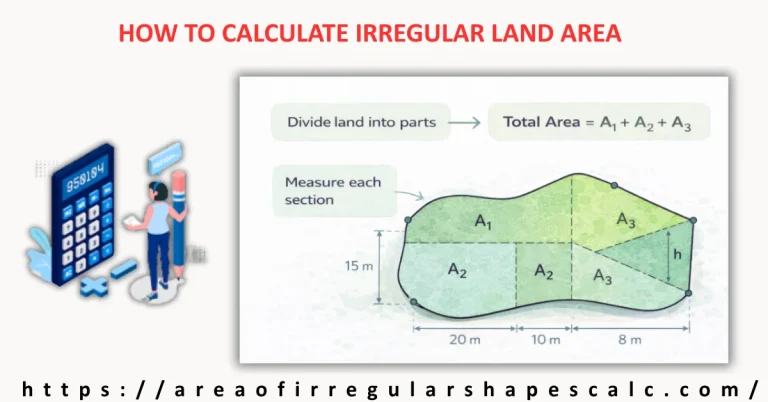
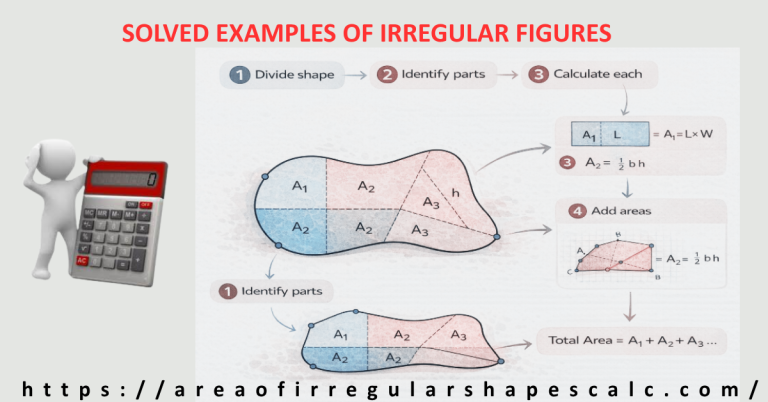
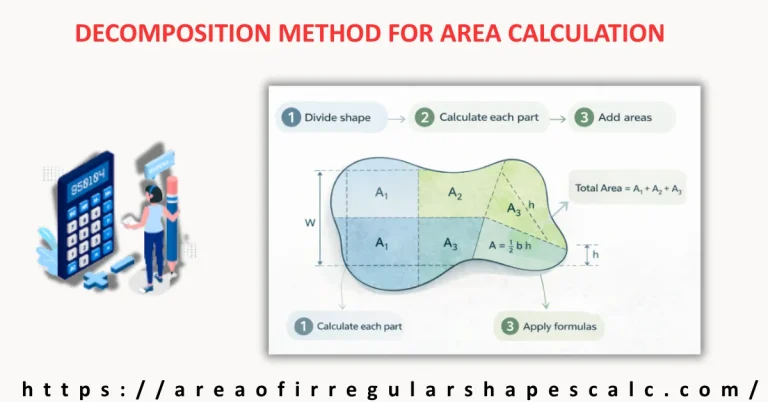
- Break the irregular shape into smaller regular shapes (rectangles, triangles, etc.)
- Calculate the area of each part
- Add all areas together
For perimeter, the approach is different:
- Identify all outer sides of the shape
- Add the lengths of all boundary edges
The key difference is important:
- Area measures the space inside
- Perimeter measures the boundary around
Keeping this distinction clear will help you avoid mistakes in the problems ahead.
Basic Practice Problems (Easy Level)
Let’s start with simple problems to build confidence.
Problem 1: L-Shaped Figure
An L-shaped figure is made of two rectangles:
- Rectangle A: 8 m × 4 m
- Rectangle B: 4 m × 3 m
Step 1: Calculate Area
Area A = 8 × 4 = 32 m²
Area B = 4 × 3 = 12 m²
Total Area = 32 + 12 = 44 m²
Step 2: Calculate Perimeter
Trace the outer boundary carefully:
Perimeter = 8 + 4 + 4 + 3 + 4 + 7 = 30 m
Key Insight
For perimeter, always follow the outer edges. Do not include internal lines used for dividing the shape.
Problem 2: Rectangle with Extension
A rectangular plot has a small rectangular extension:
- Main rectangle: 10 m × 6 m
- Extension: 3 m × 2 m
Area Calculation
Main Area = 10 × 6 = 60 m²
Extension = 3 × 2 = 6 m²
Total Area = 60 + 6 = 66 m²
Perimeter Calculation
Add all outer sides:
Perimeter = 10 + 6 + 3 + 2 + 7 + 8 = 36 m
Key Insight
Even simple shapes can become irregular when extensions are added. The method remains the same—divide and solve.
Intermediate Problems
Now let’s move to slightly more complex shapes.
Problem 3: Rectangle + Triangle Shape
A shape consists of:
- Rectangle: 12 m × 5 m
- Triangle: base 5 m, height 4 m
Step 1: Area
Rectangle Area = 12 × 5 = 60 m²
Triangle Area = ½ × 5 × 4 = 10 m²
Total Area = 60 + 10 = 70 m²
Step 2: Perimeter
Add outer edges only (including slanted triangle side if given or calculated):
Assume triangle slanted side = 6 m
Perimeter = 12 + 5 + 6 + 12 + 5 = 40 m
Key Insight
Whenever a triangle is attached, pay attention to slanted sides. These often need to be included in the perimeter.
Problem 4: Irregular Quadrilateral (Using Diagonal)
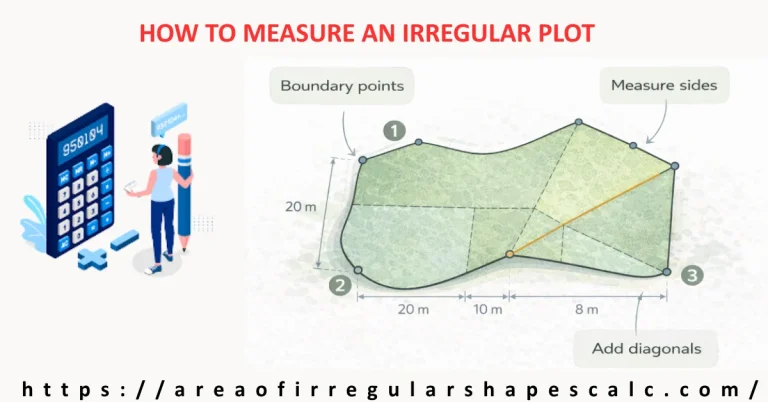
An irregular 4-sided shape is divided into two triangles.
Triangle A: – Base = 8 m – Height = 5 m
Triangle B: – Base = 6 m – Height = 4 m
Area Calculation
Area A = ½ × 8 × 5 = 20 m²
Area B = ½ × 6 × 4 = 12 m²
Total Area = 20 + 12 = 32 m²
Perimeter Calculation
Assume outer sides are: 8 m, 7 m, 6 m, 5 m
Perimeter = 8 + 7 + 6 + 5 = 26 m
Key Insight
Drawing a diagonal is one of the easiest ways to handle irregular quadrilaterals.
Advanced Problems (Multi-Part Shapes)
Now let’s challenge your understanding with a more complex example.
Problem 5: Multi-Part Irregular Shape
The shape consists of:
- Rectangle A: 10 m × 6 m
- Rectangle B: 4 m × 3 m
- Triangle C: base 4 m, height 3 m
Step 1: Area Calculation
Area A = 10 × 6 = 60 m²
Area B = 4 × 3 = 12 m²
Triangle C = ½ × 4 × 3 = 6 m²
Total Area = 60 + 12 + 6 = 78 m²
Step 2: Perimeter Calculation
Add all outer edges carefully (assume values based on layout):
Perimeter = 10 + 6 + 4 + 3 + 4 + 7 + 6 = 40 m
Key Insight
As shapes become more complex, accuracy depends on careful division and clear diagrams.
Real-Life Practice Problems
Now let’s move beyond textbook-style questions and look at how these concepts apply in real life. This is where most people actually need to calculate area and perimeter.
Problem 6: Irregular Room Layout
A room has an uneven layout:
- Main rectangle: 14 m × 10 m
- Side extension: 5 m × 4 m
Step 1: Area Calculation
Main Area = 14 × 10 = 140 m²
Extension Area = 5 × 4 = 20 m²
Total Area = 140 + 20 = 160 m²
Step 2: Perimeter Calculation
Add only outer boundaries (not internal dividing lines):
Perimeter = 14 + 10 + 5 + 4 + 9 + 10 = 52 m
Why This Matters
This is exactly how floor area is calculated for: – Tiles – Carpeting – Interior design
Problem 7: Irregular Land Plot
A plot of land is shaped irregularly and divided into two rectangles:
- Rectangle A: 20 m × 12 m
- Rectangle B: 8 m × 6 m
Area Calculation
Area A = 20 × 12 = 240 m²
Area B = 8 × 6 = 48 m²
Total Area = 240 + 48 = 288 m²
Perimeter Calculation
Assume outer sides are: 20 m, 12 m, 8 m, 6 m, 12 m, 14 m
Perimeter = 20 + 12 + 8 + 6 + 12 + 14 = 72 m
Key Insight
Land measurement problems follow the same logic as basic shapes—just on a larger scale.
Area vs Perimeter: Clearing the Confusion
Many learners mix up area and perimeter, especially when solving irregular shapes.
Area represents the space inside the shape. It tells you how much surface is covered.
Perimeter represents the total boundary length around the shape. It tells you how much fencing, edging, or boundary material is needed.
For example: – Area is used for flooring, painting, and land size – Perimeter is used for fencing, boundary walls, and framing
Understanding this difference helps you choose the correct method for each problem.
Common Mistakes in Practice Problems
Even after understanding the method, certain mistakes appear repeatedly.
One major mistake is including internal lines in perimeter calculations. Only the outer boundary should be counted.
Another issue is incorrect division of shapes. If parts overlap or leave gaps, the final area will be wrong.
Using the wrong height for triangles is also common. The height must always be perpendicular to the base.
Some people forget to add all sections when calculating total area. Missing even one small part affects the result.
Being aware of these mistakes can significantly improve accuracy.
Worksheet-Style Practice Set:
Now it’s your turn. Try solving these problems before checking the answers.
Questions
- An L-shaped figure consists of:
- Rectangle: 12 m × 6 m
- Rectangle: 5 m × 4 m
- A shape includes:
- Rectangle: 15 m × 8 m
- Triangle: base 8 m, height 5 m
- An irregular quadrilateral is divided into:
- Triangle 1: base 10 m, height 6 m
- Triangle 2: base 8 m, height 4 m
- A floor plan has:
- Main area: 16 m × 10 m
- Extension: 6 m × 4 m
Take your time and solve these step by step.
Answers with Step-by-Step Solutions
Answer 1
Area = (12×6) + (5×4) = 72 + 20 = 92 m²
Answer 2
Area = (15×8) + (½×8×5) = 120 + 20 = 140 m²
Answer 3
Area = (½×10×6) + (½×8×4) = 30 + 16 = 46 m²
Answer 4
Area = (16×10) + (6×4) = 160 + 24 = 184 m²
Frequently Asked Questions (FAQs)
1. How do I practice irregular shapes effectively?
Start with simple shapes, then gradually move to complex ones. Focus on understanding how to divide shapes rather than memorizing formulas.
2. Are these problems useful for exams?
Yes. These problems reflect the types of questions commonly asked in school exams and competitive tests.
3. What is the fastest way to solve irregular shapes?
The fastest method is decomposition—breaking the shape into rectangles and triangles.
4. How can I avoid mistakes?
Draw clear diagrams, label all dimensions, and double-check your calculations.
Final Words:
Practice is the key to mastering irregular shapes. Once you understand how to break down a shape and apply basic formulas, even the most complex figures become manageable.
The problems in this guide are designed to build your confidence step by step—from simple shapes to real-world applications.
With consistent practice, you will start recognizing patterns and solving problems faster and more accurately.