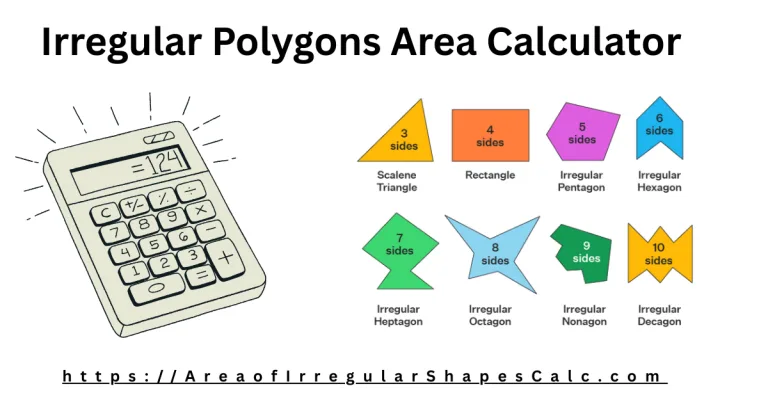
If you have ever looked at an irregular shape and felt stuck, you are not alone. Unlike squares or rectangles, these shapes do not follow a single formula. The sides are uneven, the angles are not consistent, and nothing looks straightforward at first glance.
This is exactly why many students and even professionals hesitate when asked to find the area of an irregular figure.
But here is the truth: irregular shapes are not actually difficult. They just require a different way of thinking.
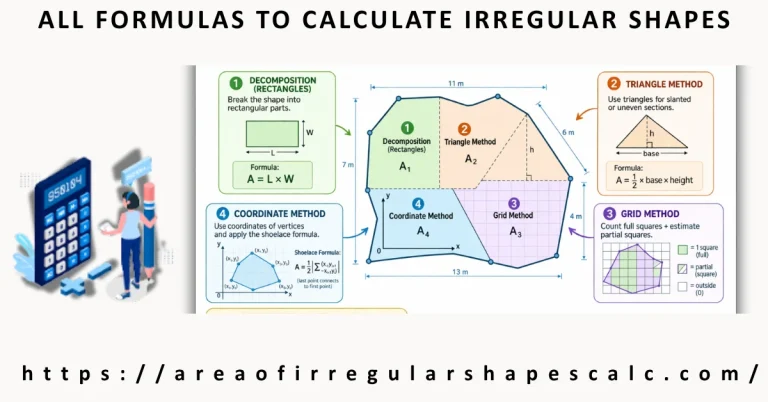
Instead of trying to solve the whole shape at once, the key is to break it down into smaller, familiar shapes like rectangles and triangles. Once you do that, the problem becomes simple and manageable.
How to Approach Any Irregular Shape
Before jumping into examples, it is important to understand a clear approach. This framework works for almost every irregular shape you will encounter.
Start by carefully observing the shape. Look for patterns or sections that resemble basic shapes like rectangles, triangles, or squares.
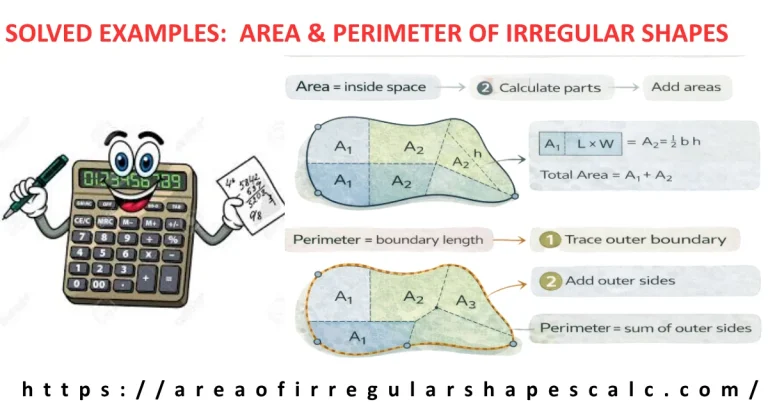
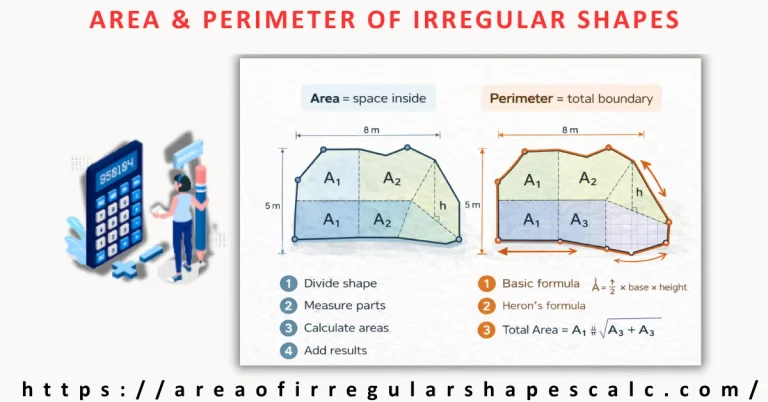
Next, divide the irregular shape into these smaller parts. This step is crucial because it transforms a complex figure into simple components that you already know how to handle.
Once the shape is divided, calculate the area of each part separately using standard formulas. For example, use length × width for rectangles and one-half × base × height for triangles.
Finally, add all the individual areas together to get the total area of the irregular shape.
This step-by-step thinking removes confusion and gives you a clear path forward every time.
Example 1: L-Shaped Irregular Figure
Let us start with a simple and very common irregular shape—an L-shaped figure.
Imagine a shape that looks like two rectangles joined together. Instead of treating it as one complex figure, we divide it into two smaller rectangles.
Step 1: Divide the Shape
Split the L-shape into: – Rectangle A – Rectangle B
Step 2: Measure Dimensions
Assume: – Rectangle A = 8 m × 4 m – Rectangle B = 5 m × 3 m
Step 3: Calculate Area of Each Part
Area of Rectangle A = 8 × 4 = 32 m²
Area of Rectangle B = 5 × 3 = 15 m²
Step 4: Add the Areas
Total Area = 32 + 15 = 47 m²
Key Insight
The shape looked complicated at first, but dividing it into rectangles made it easy to solve. This is the most common technique used in real-world problems like room layouts and floor plans.
Example 2: Rectangle + Triangle Combination
Now let us look at a slightly more interesting shape—one that combines a rectangle and a triangle.
This type of shape often appears in roofs, plots, and construction layouts.
Step 1: Identify Components
Divide the shape into: – One rectangle – One triangle
Step 2: Given Dimensions
Assume: – Rectangle = 10 m × 6 m – Triangle = base 6 m, height 4 m
Step 3: Calculate Areas
Rectangle Area = 10 × 6 = 60 m²
Triangle Area = ½ × 6 × 4 = 12 m²
Step 4: Total Area
Total Area = 60 + 12 = 72 m²
Key Insight
Whenever you see a slanted edge, there is a high chance that part of the shape can be treated as a triangle. Recognizing this quickly makes problem-solving faster and more efficient.
Example 3: Irregular 4-Sided Shape (Divide into Triangles)
Now let us move to a more advanced example—an irregular four-sided shape where all sides are different.
This is where many people get confused because the shape does not resemble any standard figure.
The solution is to draw a diagonal line that divides the shape into two triangles.
Step 1: Draw a Diagonal
Split the quadrilateral into: – Triangle A – Triangle B
Step 2: Assume Measurements
Triangle A: – Base = 7 m – Height = 5 m
Triangle B: – Base = 6 m – Height = 4 m
Step 3: Calculate Areas
Area of Triangle A = ½ × 7 × 5 = 17.5 m²
Area of Triangle B = ½ × 6 × 4 = 12 m²
Step 4: Add Areas
Total Area = 17.5 + 12 = 29.5 m²
Key Insight
When dealing with irregular four-sided shapes, drawing a diagonal is one of the most powerful techniques. It converts a confusing shape into two simple triangles that are easy to solve.
Example 4: Complex Irregular Shape (Multiple Parts)
Let’s now solve a shape that looks messy at first glance—something you might see in a construction plan or a land sketch. The key here is not to panic, but to break it down patiently.
Imagine an irregular figure that can be divided into three parts: two rectangles and one triangle.
Step 1: Visual Breakdown
Sketch the shape and identify natural breakpoints. Split it into: – Rectangle A – Rectangle B – Triangle C
Step 2: Given Dimensions
Assume: – Rectangle A = 6 m × 4 m – Rectangle B = 3 m × 5 m – Triangle C = base 3 m, height 4 m
Step 3: Calculate Individual Areas
Area of Rectangle A = 6 × 4 = 24 m²
Area of Rectangle B = 3 × 5 = 15 m²
Area of Triangle C = ½ × 3 × 4 = 6 m²
Step 4: Add Everything
Total Area = 24 + 15 + 6 = 45 m²
Key Insight
Complex shapes are just a combination of simple shapes. The more confidently you can divide a figure, the easier the solution becomes.
Example 5: Real-Life Floor Plan (Irregular Room)
Now let’s apply the same idea to a real-world scenario.
Suppose you have a room that is not perfectly rectangular. One side extends outward, creating an uneven layout.
Step 1: Divide the Room
Break the floor plan into: – Main rectangular area – Smaller rectangular extension
Step 2: Measurements
Assume: – Main room = 12 m × 8 m – Extension = 4 m × 3 m
Step 3: Calculate Areas
Main Area = 12 × 8 = 96 m²
Extension Area = 4 × 3 = 12 m²
Step 4: Total Floor Area
Total Area = 96 + 12 = 108 m²
Why This Matters
This exact method is used in: – Interior planning – Flooring estimation – Real estate measurements
Once you understand this, you can easily calculate the area of irregular rooms without confusion.
Common Mistakes When Solving Irregular Shape Problems
Even when the method is clear, small mistakes can lead to wrong answers. Here are the most common ones to avoid.
Many people divide the shape incorrectly. If the parts do not fully cover the shape or overlap, the final answer will be wrong.
Another mistake is using incorrect dimensions. For triangles, the height must be perpendicular to the base. Using a slanted side instead of height leads to errors.
Some learners forget to include all sections. Missing even a small portion can significantly affect the total area.
Unit inconsistency is another issue. Mixing meters and centimeters without conversion results in incorrect values.
Taking a moment to review your steps can prevent most of these problems.
Tips to Solve Irregular Shapes Faster
As you practice more, you will start recognizing patterns. These tips can help you solve problems more efficiently.
Look for rectangles first. They are the easiest to calculate and often form the main part of the shape.
Use diagonals when dealing with four-sided irregular figures. This quickly converts the shape into triangles.
Keep your diagram neat. A clean sketch makes it easier to track measurements and avoid confusion.
Work step by step. Avoid jumping directly to the final answer.
With consistent practice, solving irregular shapes becomes quick and almost automatic.
Practice Problems & Worksheet (With Answers)
If you want to build confidence, try solving these worksheet-style problems. These are designed to reflect real exam and practical scenarios.
Practice Questions
- An L-shaped figure consists of:
- Rectangle 1: 10 m × 5 m
- Rectangle 2: 4 m × 3 m
Find the total area.
- A shape is made of:
- Rectangle: 8 m × 6 m
- Triangle: base 6 m, height 5 m
Find the total area.
- An irregular quadrilateral is divided into two triangles:
- Triangle 1: base 9 m, height 4 m
- Triangle 2: base 7 m, height 3 m
Find the total area.
Answers
- Area = (10×5) + (4×3) = 50 + 12 = 62 m²
- Area = (8×6) + (½×6×5) = 48 + 15 = 63 m²
- Area = (½×9×4) + (½×7×3) = 18 + 10.5 = 5 m²
You can reuse these problems as your own worksheet or practice set.
Frequently Asked Questions (FAQs)
1. How do you solve irregular shapes step by step?
Break the shape into smaller regular shapes, calculate each part separately, and then add the areas together.
2. What is the easiest method for irregular shapes?
The decomposition method is the easiest. It involves dividing the shape into rectangles and triangles.
3. Can every irregular shape be solved this way?
Yes. Any irregular shape can be broken down into simpler shapes, making it possible to calculate its area.
4. How do I know where to divide the shape?
Look for straight lines or natural divisions where the shape can be split into rectangles or triangles.
Final Words
Irregular shapes may look complicated at first, but the method to solve them is always the same—divide, calculate, and combine.
By practicing different types of problems, from simple L-shapes to more complex figures, you develop the ability to quickly identify the best way to break down a shape.
The examples in this guide are designed to build that confidence step by step.
With time, what once looked confusing will become straightforward, and you will be able to solve irregular shape area problems with ease.