Irregular Parallelogram & Rhombus Area Calculator
Calculate area using base × height, diagonals, or sides & angle.
At first glance, calculating the area of a parallelogram or a rhombus feels simple. You probably remember the formula from school, and it seems straightforward.
But the moment the shape becomes slanted — not perfectly upright like a rectangle or square — confusion starts creeping in.
You look at the shape and hesitate. Is this side the base? Is that slanted edge the height? Does the same formula even apply here?
This is exactly where most people get stuck.
The reality is surprisingly simple: the formula never changes. What changes is how you identify the correct measurements.
Once you understand that difference, even an irregular parallelogram or a tilted rhombus becomes easy to handle.
Understanding Irregular Parallelogram and Irregular Rhombus
Before jumping into calculations, it helps to clearly understand what these shapes actually are.
A parallelogram is a four-sided shape where opposite sides are parallel. When it is perfectly aligned, it may look like a rectangle. But when it is pushed sideways, it becomes a slanted parallelogram — often called an irregular parallelogram in practical use.
A rhombus, on the other hand, is a special type of parallelogram where all four sides are equal. It often appears like a diamond shape, especially when tilted. When its angles are not 90°, people often refer to it as an irregular rhombus.
Even though these shapes look different visually, mathematically they still follow the same rules.
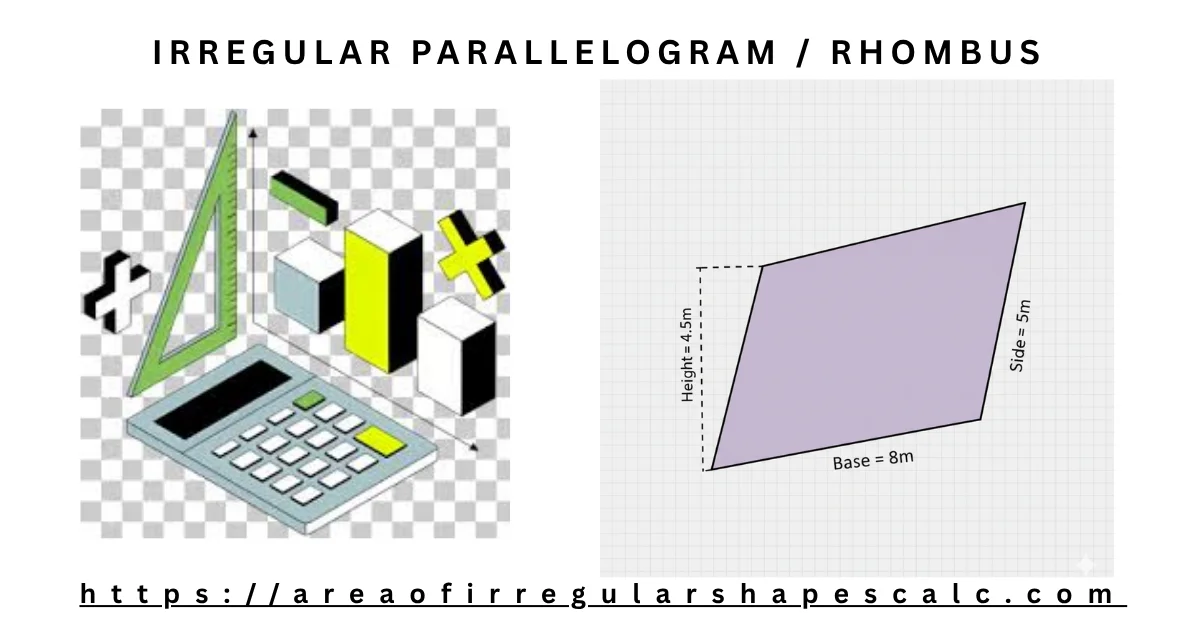
Why Slanted Shapes Make Area Calculation Confusing
Most mistakes happen not because the formula is difficult, but because the shape looks misleading.
When a parallelogram is slanted, your eyes naturally follow the tilted side. It feels logical to use that side as the height — but that is incorrect.
In geometry, height is always the perpendicular distance between two parallel sides. It is the shortest distance, not the slanted edge.
This is the core reason why people struggle when trying to calculate the area of a parallelogram or rhombus in real-world layouts.
Area of a Parallelogram (Formula That Always Works)
No matter how the shape looks — straight or slanted — the area of a parallelogram is always calculated using the same formula:
A = base × height
Here, the base is any one side of the parallelogram, and the height is the perpendicular distance from that base to the opposite side.
The key detail is this: the height must be perpendicular. If you use the slanted side instead, the result will be incorrect.
Area of an Irregular Parallelogram
An irregular parallelogram is simply a slanted version of the same shape. The angles are not right angles, but opposite sides are still parallel.
Because of this, the formula does not change at all.
A = base × perpendicular height
The challenge is only in identifying the correct height. In many real-world situations — like land measurement or construction layouts — this is where errors occur.
As long as you measure the perpendicular height correctly, the area will always be accurate, no matter how tilted the shape appears.
How to Calculate Area of a Rhombus
A rhombus gives you two different ways to calculate area, both equally valid depending on the information you have.
Using Diagonals (Most Practical Method)
In a rhombus, the diagonals intersect at right angles and bisect each other. This makes them very useful for calculation.
A = (d₁ × d₂) / 2
This method is especially helpful when diagonal lengths are known, because it avoids dealing with height or angles.
Using Base and Height
You can also treat a rhombus like a parallelogram:
A = base × height
Again, the same rule applies — height must be perpendicular, not the slanted side.
Area of an Irregular Rhombus
An irregular rhombus is simply a rhombus that appears stretched or tilted. All sides are still equal, but angles vary.
Even in this case, the formulas remain exactly the same:
- Using diagonals
- Using base and perpendicular height
In practice, the diagonal method is often easier and more reliable, especially when measuring real objects.
Parallelogram vs Rhombus Area
Both shapes follow very similar rules because a rhombus is technically a type of parallelogram.
The main difference lies in how measurements are taken:
- A parallelogram typically uses base and height
- A rhombus can use either diagonals or base and height
This flexibility makes rhombus calculations slightly more convenient in many situations.
Step-by-Step Examples:
Let’s apply these concepts to real numbers so everything becomes clear.
Example 1: Slanted Parallelogram
Base = 12 m Height = 5 m
Area = 12 × 5 = 60 m²
Even though the shape is tilted, the calculation depends only on base and perpendicular height.
Example 2: Rhombus Using Diagonals
Diagonal 1 = 10 m Diagonal 2 = 8 m
Area = (10 × 8) / 2 = 40 m²
This method avoids confusion about angles or orientation.
Example 3: Rhombus Using Base and Height
Base = 7 m Height = 6 m
Area = 7 × 6 = 42 m²
Both methods give correct results when applied properly.
Common Mistakes in Slanted Shape Calculations
Most errors come from misunderstanding the shape rather than the formula.
One of the biggest mistakes is using the slanted side as the height. This leads to overestimation of area.
Another issue is mixing different methods in rhombus calculations — for example, using one diagonal with base-height logic.
A reliable approach is to first identify what measurements you actually have, and then stick to one method consistently.
When to Use This Calculator
This type of calculator becomes especially useful in real-world scenarios where shapes are rarely perfect.
If you are working with tilted layouts, slanted boundaries, or diamond-shaped structures, manual calculation can easily lead to mistakes.
A calculator helps you apply the correct formula with the right inputs, removing confusion and saving time.
FAQs
1. How to calculate area of a rhombus?
You can use either diagonals or base × height. Both methods are correct if measurements are accurate.
2. How do I calculate the area of a parallelogram?
Multiply the base by the perpendicular height. Do not use the slanted side as height.
3. Does a slanted shape change the formula?
No. The formula remains the same. Only the way you measure height changes.
4. Which method is better for a rhombus?
The diagonal method is often more practical when diagonal lengths are available.