If you have ever tried to measure the area of an uneven piece of land, a strangely shaped room, or a sketch that does not follow clean geometric lines, you already know the problem — there is no obvious formula to apply.
Unlike a square or rectangle, where you simply multiply two numbers, irregular shapes force you to pause and think. You may find yourself asking:
Is this side the base? Where is the height? Should I divide this shape or treat it as one figure?
This confusion is completely natural. The difficulty does not come from the mathematics itself, but from how the shape is presented.
In real-world scenarios — construction layouts, land measurement, architectural planning — shapes are rarely perfect. They are tilted, extended, or uneven. The challenge is not solving them, but understanding how to approach them correctly.
Once you understand the underlying methods, measuring the area of irregular shapes becomes a structured and predictable process rather than a guessing game.
What Does “Measuring Area of an Irregular Shape” Actually Mean?
At its core, measuring the area of an irregular shape means finding the total surface covered by a figure that does not follow standard geometric rules.
Unlike regular shapes, there is no single universal formula that works in every situation. Instead, irregular shapes are solved using a combination of known geometric principles.
The key idea is simple but powerful:
You do not calculate an irregular shape directly — you transform it into smaller, familiar shapes that you already know how to measure.
This transformation can happen in multiple ways:
- Breaking the shape into rectangles or triangles
- Dividing it into smaller geometric sections
- Using coordinate points to calculate area mathematically
- Estimating area through grids when precision is not required
Once you adopt this mindset, irregular shapes stop being “irregular” in a practical sense. They simply become a collection of solvable parts.
Overview of All Methods to Measure Irregular Shapes
Before diving into each method in detail, it is important to understand the overall landscape of approaches available.
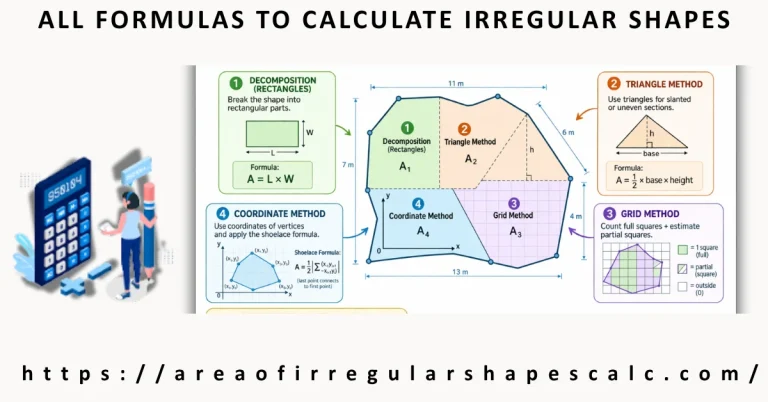
All techniques used to measure irregular shapes fall into four main categories.
The first is the decomposition method, where the shape is broken into smaller regular shapes such as rectangles and triangles.
The second is triangulation, which converts the entire shape into multiple triangles and solves each one individually.
The third is coordinate geometry, where the shape is defined using points on a grid and calculated using mathematical formulas.
The fourth is the grid or approximation method, which estimates the area by counting squares overlaid on the shape.
Each method serves a specific purpose. The effectiveness of a method depends not on the shape itself, but on the type of information available to you.
Understanding when to use which method is what separates a beginner from someone who can confidently solve any irregular shape.
Method 1: Decomposition (Breaking the Shape into Simple Parts)
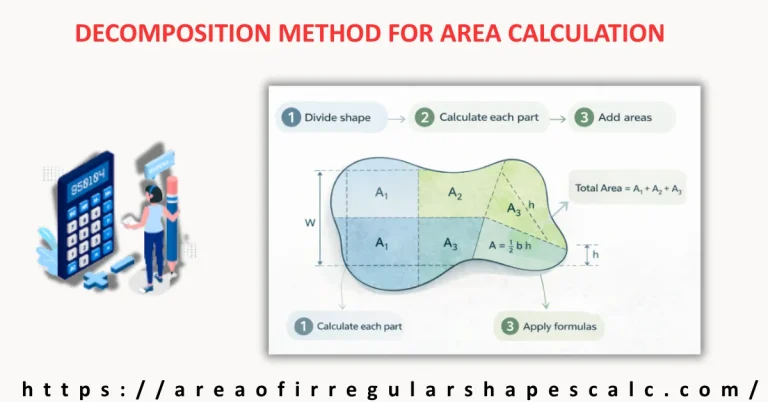
The decomposition method is the most practical and widely used approach for measuring irregular shapes.
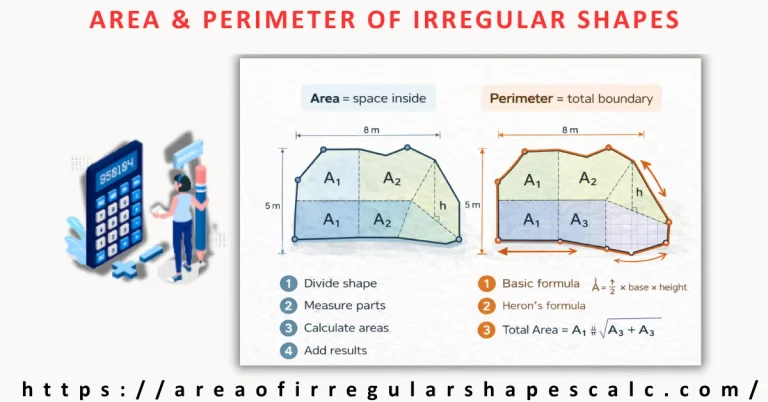
Instead of trying to calculate the entire figure at once, you divide it into smaller, recognizable shapes such as rectangles, triangles, or trapezoids. Each part is then calculated separately, and the results are added together.
This method works because the total area of a shape is simply the sum of the areas of its parts.
For example, imagine an L-shaped floor plan. At first glance, it looks complicated. But if you split it into two rectangles, the problem becomes straightforward.
Calculate the area of the first rectangle, then the second, and add them together. The complexity disappears.
What makes decomposition powerful is its flexibility. There is no single “correct” way to divide a shape. You can choose the simplest breakdown based on the measurements you have.
This method is especially useful in real-life situations such as:
- Measuring floor space
- Calculating land area
- Estimating construction materials
As long as you can identify clear sections within the shape, decomposition provides a reliable and intuitive solution.
Method 2: Triangulation (Solving Using Triangles)
While decomposition works well with rectangles and simple shapes, some irregular figures are better handled using triangles. This is where triangulation becomes useful.
In this method, the entire shape is divided into multiple triangles. Each triangle is then solved individually using known formulas, and all areas are combined.
This approach is particularly effective for shapes with uneven sides or complex boundaries, where rectangles do not fit naturally.
The simplest triangle formula is based on base and height. However, in many real-world cases, height is not easily visible or measurable. In such situations, you can rely on formulas that use only side lengths.
This makes triangulation extremely useful in surveying, mapping, and irregular land measurements.
Another advantage of this method is consistency. Regardless of how complex the shape appears, breaking it into triangles always leads to a solvable structure.
Think of triangulation as a universal fallback method — when other approaches seem confusing, triangles almost always provide a clear path forward.
Method 3: Coordinate Geometry (Using Points and Formulas)
When the shape is defined using coordinates — for example, points on a map or grid — a completely different approach becomes available.
Instead of dividing the shape visually, you calculate its area using the positions of its vertices. This method is often referred to as coordinate geometry.
It is widely used in fields such as:
- Land surveying
- Geographic mapping (GIS)
- Computer graphics and design
The strength of this method lies in its precision. Once the coordinates are known, the area can be calculated systematically without estimating or dividing the shape manually.
Although the calculation process may seem more technical at first, it actually simplifies complex shapes into a structured numerical procedure.
This method is ideal when accuracy is critical and coordinate data is available.
Method 4: Grid / Approximation Method
Not every situation requires exact precision. In many practical cases, an estimate of the area is sufficient.
The grid method is designed for such situations.
In this approach, the irregular shape is placed over a grid of equal-sized squares. The area is then estimated by counting how many squares fall inside the shape.
Full squares are counted directly, while partial squares are combined to form whole units.
This method is commonly used in:
- Map reading
- Sketch-based planning
- Early-stage design work
While it may not produce exact results, it offers a quick and visual way to approximate area without complex calculations.
How to Choose the Right Method
With multiple methods available, the real skill lies in choosing the right one for the situation.
If the shape can be easily divided into rectangles or simple parts, the decomposition method is usually the best starting point.
If the shape is uneven and only side lengths are available, triangulation provides a more reliable solution.
If the shape is defined using coordinates, the coordinate geometry method offers the highest level of accuracy.
If the shape is rough or drawn without precise measurements, the grid method allows for quick estimation.
The goal is not to memorize all methods, but to recognize which one fits the data you have.
Once this decision-making becomes intuitive, solving irregular shapes becomes significantly easier and more efficient.
Step-by-Step Solved Examples:
Understanding methods is important, but real clarity comes when you see them applied in practical situations. Below are step-by-step examples using different approaches so you can confidently handle irregular shapes in real life.
Example 1: Decomposition Method (Irregular Floor Shape)
Imagine an irregular floor plan that looks like an L-shape. You divide it into two rectangles:
- Rectangle A: length = 12 m, width = 5 m
- Rectangle B: length = 6 m, width = 4 m
Step 1: Calculate area of Rectangle A
Area = length × width = 12 × 5 = 60 m²
Step 2: Calculate area of Rectangle B
Area = 6 × 4 = 24 m²
Step 3: Add both areas
Total Area = 60 + 24 = 84 m²
This method is widely used in construction and interior planning where layouts are not perfectly rectangular.
Example 2: Triangulation Method (Irregular Land Plot)
Suppose you have an irregular land plot divided into two triangles.
Triangle 1: – base = 10 m, height = 6 m
Triangle 2: – base = 8 m, height = 5 m
Step 1: Calculate area of Triangle 1
Area = ½ × base × height = ½ × 10 × 6 = 30 m²
Step 2: Calculate area of Triangle 2
Area = ½ × 8 × 5 = 20 m²
Step 3: Add both areas
Total Area = 30 + 20 = 50 m²
This approach is especially useful when the shape is uneven and rectangles do not fit naturally.
Example 3: Coordinate Method (Plot on Map)
You are given coordinates of a land boundary: (2,3), (6,7), (8,4), (4,2)
Step 1: Arrange coordinates in sequence and repeat first point
(2,3), (6,7), (8,4), (4,2), (2,3)
Step 2: Apply multiplication pattern
Sum1 = (2×7) + (6×4) + (8×2) + (4×3) = 14 + 24 + 16 + 12 = 66
Sum2 = (3×6) + (7×8) + (4×4) + (2×2) = 18 + 56 + 16 + 4 = 94
Step 3: Final calculation
Area = ½ × |66 − 94| = ½ × 28 = 14 square units
This method is commonly used in surveying and mapping applications where coordinates are available.
Common Mistakes When Measuring Irregular Shapes
Even when the method is correct, small mistakes can lead to large errors in the final result.
One common mistake is incorrect division of the shape. If the shape is split poorly, some areas may overlap or be missed entirely.
Another issue is using the wrong measurement as height. In slanted shapes, the vertical height is often confused with the slanted side, which leads to incorrect calculations.
Unit inconsistency is also a frequent problem. Mixing meters with centimeters or feet without proper conversion results in inaccurate answers.
Additionally, skipping steps or rushing calculations can create compounding errors, especially when multiple shapes are involved.
The safest approach is to work step by step and verify each part before combining results.
Real-Life Applications of Measuring Irregular Shapes
The importance of these methods goes far beyond classroom problems. In real-world situations, irregular shapes are the norm rather than the exception.
In land measurement, property boundaries are rarely perfect rectangles. Surveyors use triangulation and coordinate methods to calculate accurate areas.
In architecture and construction, floor layouts often include extensions, corners, and uneven sections. Decomposition helps estimate materials such as tiles, paint, or flooring.
In mapping and geographic systems, irregular regions are calculated using coordinate-based methods for high precision.
Even in everyday situations, such as measuring a garden or planning furniture placement, these techniques help convert complex shapes into manageable calculations.
Understanding these applications reinforces why mastering these methods is both practical and valuable.
Frequently Asked Questions (FAQs)
1. How do you measure the area of an irregular shape?
Break the shape into smaller regular shapes, calculate each part, and add the results together.
2. What is the best method for irregular shapes?
It depends on the data available. Decomposition works best for visual shapes, triangulation for uneven sides, and coordinate methods for mapped points.
3. Can irregular shapes be measured without formulas?
Yes, approximation methods like grid counting can provide reasonable estimates when precision is not required.
4. Why is triangulation useful?
Triangles are the simplest geometric shapes, and any irregular shape can be broken down into triangles, making calculations more manageable.
5. Is there a single formula for irregular shapes?
No. Irregular shapes require a combination of methods rather than a single formula.
Final Words:
Measuring the area of irregular shapes is not about finding a single formula, but about choosing the right method for the situation.
Whether you use decomposition, triangulation, coordinate geometry, or approximation, the underlying principle remains the same: simplify the shape into something you can calculate.
With practice, these methods become intuitive, allowing you to handle even the most complex shapes with confidence and accuracy.