When working with standard geometric shapes like squares, rectangles, or circles, calculating area is straightforward because each shape follows a fixed mathematical rule. However, irregular shapes do not follow uniform patterns. Their sides may be unequal, angles may vary, and boundaries may not align with standard geometric definitions.
This is why there is no single universal formula for calculating the area of irregular shapes.
Instead, the concept of “area formulas” for irregular shapes is built on a system of methods. Each method uses known formulas from regular shapes and applies them strategically to parts of the irregular figure.
Understanding this shift—from one formula to a combination of formulas—is the key to mastering irregular shape calculations.
How Area Formulas Work for Irregular Shapes
Unlike regular shapes, where one formula gives a direct answer, irregular shapes require a structured approach. The area is calculated by transforming the shape into smaller, manageable parts or by using mathematical techniques that adapt to complexity.
There are three core ideas behind all irregular shape area formulas:
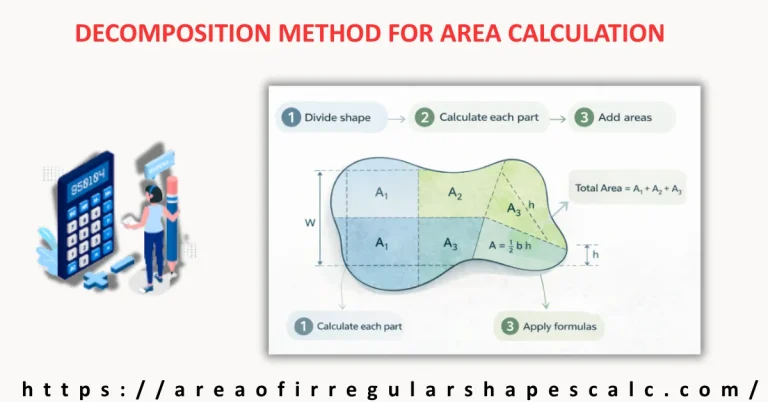
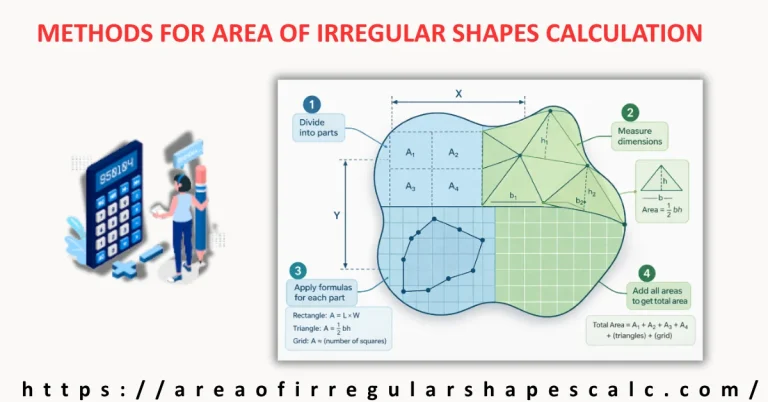
First, decomposition. This involves breaking the shape into smaller, regular shapes such as rectangles, triangles, or trapezoids. Each part is calculated separately and then combined.
Second, approximation. When exact measurements are difficult, methods like grid counting are used to estimate the area.
Third, coordinate-based calculation. When the vertices of a shape are known, formulas from coordinate geometry can be applied to calculate area precisely.
These three concepts form the foundation of all formulas used for irregular shapes.
Primary Formula Method: Decomposition Approach
The most widely used and reliable way to calculate the area of an irregular shape is the decomposition method. Instead of trying to solve the entire shape at once, you divide it into smaller shapes with known formulas.
The general formula for this approach can be expressed as:
Total Area = Area₁ + Area₂ + Area₃ + …
Each component represents a regular shape such as a rectangle, triangle, or trapezoid.
For example, if an irregular shape is divided into two rectangles and one triangle, the total area is calculated by finding each part individually and adding the results.
This method is powerful because it converts a complex problem into a series of simple calculations. It also provides flexibility, allowing you to divide the shape in different ways depending on what is easiest to measure.
Common Formulas Used in Decomposition
Rectangle: Area = length × width
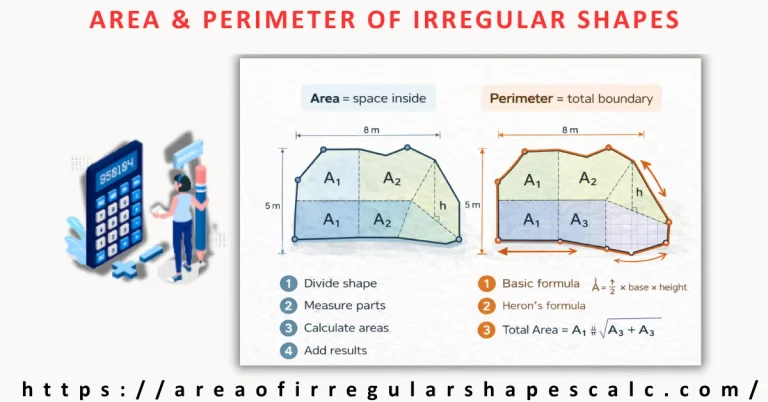
Triangle: Area = ½ × base × height
Trapezoid: Area = ½ × (sum of parallel sides) × height
By combining these formulas, you can calculate the area of almost any irregular shape.
Triangle-Based Formulas for Irregular Shapes
Many irregular shapes can be effectively solved by converting them into triangles. This approach is especially useful when dealing with polygons that have uneven sides or complex boundaries.
The simplest triangle formula is:
Area = ½ × base × height
However, in many real-world cases, the height is not directly available. In such situations, Heron’s Formula becomes extremely useful.
Heron’s Formula allows you to calculate the area of a triangle using only the lengths of its three sides:
s = (a + b + c) / 2 Area = √[s(s − a)(s − b)(s − c)]
This method is particularly valuable when working with irregular polygons, where the shape can be divided into multiple triangles with known side lengths.
By summing the areas of these triangles, the total area of the irregular shape can be determined accurately.
Coordinate Geometry Formula (Shoelace Method)
When the coordinates of the vertices of an irregular shape are known, the area can be calculated using a coordinate-based formula known as the shoelace method.
This method is widely used in surveying, mapping, and engineering because it provides precise results without needing to divide the shape manually.
The formula works by arranging the coordinates in a sequence and applying a structured calculation that multiplies and subtracts coordinate pairs.
The result is then divided by 2 to obtain the area.
This approach is particularly useful for irregular polygons where side lengths and angles are difficult to measure directly but coordinate points are available.
When to Use the Shoelace Formula
Use this method when: – You have exact coordinate points – The shape is plotted on a grid or map – High accuracy is required
This formula transforms geometric complexity into a straightforward numerical process.
Grid / Unit Square Formula Method
In situations where precise measurements are not available, the grid method provides a practical way to estimate the area of irregular shapes.
In this approach, the shape is placed over a grid made of equal-sized squares. The area is then calculated by counting how many squares fall within the shape.
The formula can be expressed as:
Area ≈ (Number of full squares) + (Estimated partial squares)
Full squares are counted directly, while partial squares are combined to form whole units.
This method is especially useful for quick estimations, visual calculations, or when working with maps and diagrams.
Although it may not provide exact results, it is often accurate enough for planning and preliminary analysis.
Derived Formulas for Specific Irregular Shapes
Once the core methods are understood, the next step is applying formulas to specific irregular shapes. In practice, many irregular figures fall into recognizable categories such as quadrilaterals, polygons, or multi-sided shapes. Each of these can be handled using structured formula approaches.
1). Irregular Quadrilateral Area Formula
An irregular quadrilateral has four sides of unequal length and angles that are not consistent. There is no single direct formula, but it can be solved by dividing the shape into two triangles.
The general approach is:
Total Area = Area of Triangle 1 + Area of Triangle 2
Each triangle can then be solved using: – Base-height formula (½ × base × height) – Heron’s formula (if only side lengths are known)
This method is widely used in land measurement and surveying.
2). Irregular Polygon Area Formula
For polygons with more than four sides, the same principle applies but at a larger scale. The shape is divided into multiple triangles.
Total Area = Sum of areas of all triangles
Alternatively, when coordinates are available, the shoelace formula provides a direct and efficient solution.
This makes it suitable for maps, GIS data, and digital design applications.
3). Irregular Pentagon and Hexagon Formulas
Irregular pentagons and hexagons do not have fixed formulas, but they can be solved using a combination of triangle-based methods and decomposition.
The key idea is consistency: – Divide into triangles – Calculate each triangle – Add all areas together
This structured approach works regardless of how complex the shape appears.
Surface Area of Irregular Shapes
So far, we have focused on two-dimensional shapes. However, the concept of irregular shapes extends into three dimensions as well.
Surface area refers to the total area covering the outer surface of a 3D object. For irregular 3D shapes, there is no single formula. Instead, each surface is treated as an individual shape.
The process involves: – Breaking the object into flat surfaces – Calculating the area of each surface – Adding them together
This method is commonly used in engineering, architecture, and manufacturing.
Understanding surface area builds on the same principles used in 2D irregular shapes, making it a natural extension of the topic.
How to Choose the Right Formula:
One of the biggest challenges learners face is deciding which method or formula to use. Since multiple approaches exist, choosing the right one depends on the information available.
If the shape can be easily divided into simple parts, the decomposition method is usually the best option.
If only side lengths are available, triangle-based formulas such as Heron’s formula are more suitable.
If the coordinates of the vertices are known, the shoelace formula provides the most efficient and accurate solution.
If measurements are rough or incomplete, the grid method offers a quick estimation.
The goal is not to memorize every formula, but to understand which approach fits the situation. This flexibility is what makes irregular shape calculations practical and reliable.
Common Mistakes When Using Area Formulas
Even with the correct formulas, mistakes can occur if the process is not handled carefully.
One common issue is incorrect division of the shape. Poor decomposition can lead to overlapping areas or missing sections, which affects the final result.
Another mistake is using the wrong formula for a given situation. For example, applying a rectangle formula to a non-rectangular section can produce incorrect values.
Unit inconsistency is also a frequent problem. Mixing units such as meters and centimeters without proper conversion leads to errors.
Additionally, calculation errors—especially in multi-step problems—can accumulate and distort the final answer.
Avoiding these mistakes requires careful planning, consistent units, and step-by-step verification.
Solved Examples Using Different Formulas
Understanding formulas becomes much easier when you see them applied step by step. Below are practical examples that demonstrate how to calculate the area of irregular shapes using different methods.
Example 1: Using Decomposition Method (Rectangle + Triangle)
Suppose you have an irregular shape that can be divided into: – One rectangle (length = 10 m, width = 6 m) – One triangle (base = 8 m, height = 5 m)
Step 1: Calculate the area of the rectangle Area = length × width
= 10 × 6 = 60 m²
Step 2: Calculate the area of the triangle Area = ½ × base × height
= ½ × 8 × 5 = 20 m²
Step 3: Add both areas Total Area = 60 + 20 = 80 m²
This is one of the most common real-world methods used for floor plans and land plots.
Example 2: Using Heron’s Formula (Only Side Lengths Known)
You are given a triangle within an irregular shape with sides: – a = 7 m, b = 8 m, c = 9 m
Step 1: Calculate semi-perimeter (s) s = (a + b + c) / 2
= (7 + 8 + 9) / 2 = 12
Step 2: Apply Heron’s formula Area = √[s(s-a)(s-b)(s-c)]
= √[12(12-7)(12-8)(12-9)]
= √[12 × 5 × 4 × 3]
= √720 ≈ 26.83 m²
If the irregular shape consists of multiple such triangles, repeat this process and sum all areas.
Example 3: Using Coordinate Geometry (Shoelace Formula)
Suppose an irregular polygon has coordinates: (1,2), (4,5), (6,3), (3,1)
Step 1: Arrange coordinates in order and repeat the first point at the end (1,2), (4,5), (6,3), (3,1), (1,2)
Step 2: Apply the shoelace formula Sum1 = (1×5) + (4×3) + (6×1) + (3×2) = 5 + 12 + 6 + 6 = 29
Sum2 = (2×4) + (5×6) + (3×3) + (1×1) = 8 + 30 + 9 + 1 = 48
Step 3: Compute area Area = ½ × |Sum1 − Sum2|
= ½ × |29 − 48| = ½ × 19 = 9.5 square units
This method is especially useful in mapping, surveying, and digital applications.
Frequently Asked Questions (FAQs)
1. What is the formula for irregular shapes?
There is no single formula. The area is calculated using a combination of methods such as decomposition, triangle formulas, and coordinate geometry.
2. How do you calculate the area of irregular shapes?
Break the shape into smaller regular shapes, calculate each area, and add them together.
3. Which formula is best for irregular polygons?
If coordinates are available, the shoelace formula is the most efficient. Otherwise, dividing the shape into triangles is a reliable method.
4. Can irregular shapes be solved using only side lengths?
Yes. By dividing the shape into triangles and using Heron’s formula, area can be calculated without needing height measurements.
5. Why are there multiple formulas for irregular shapes?
Irregular shapes vary in structure, so different methods are required depending on the available information and complexity of the shape.
Final Words
Area formulas for irregular shapes are not about memorizing a single equation. Instead, they are built on a flexible system of methods that adapt to different shapes and situations.
By understanding decomposition, triangle-based formulas, coordinate methods, and estimation techniques, you gain the ability to solve any irregular shape with confidence.
The key is to focus on understanding the logic behind the formulas rather than trying to apply a one-size-fits-all approach. With practice, these methods become intuitive, allowing you to handle both academic problems and real-world applications effectively.