If you look at a perfect rectangle, the solution is obvious — multiply length by width. But the moment a shape becomes uneven, extended, or broken into parts, that simplicity disappears.
This is exactly where most people get stuck.
A land plot may have bends. A room layout may include extensions. A sketch may not follow clean lines. In all such cases, the question is no longer “what formula to use,” but rather “how to even start.”
This confusion creates the false impression that irregular shapes are complicated.
In reality, the complexity does not lie in the mathematics. It lies in how the shape is presented.
Once you understand how to reorganize the shape into something familiar, the problem becomes straightforward. That is exactly what the decomposition method is designed to do.
What is the Decomposition Method?
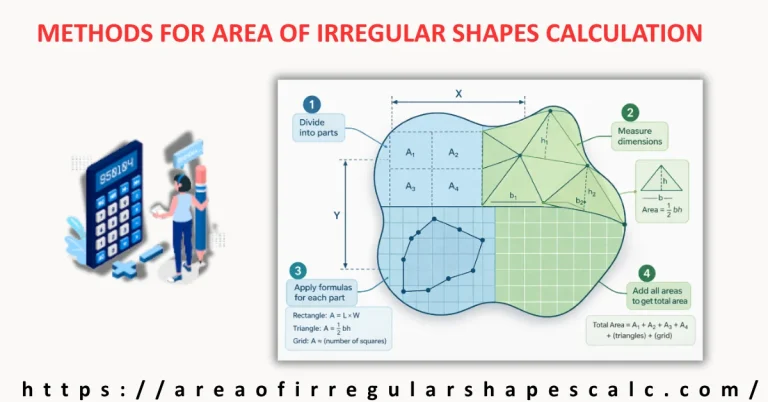
The decomposition method is a practical technique used to calculate the area of irregular shapes by breaking them into smaller, regular shapes.
Instead of trying to solve the entire shape at once, you divide it into parts such as rectangles, triangles, or trapezoids. Each of these smaller shapes has a well-known formula, which makes calculation simple and reliable.
Once all individual areas are calculated, they are added together to get the total area.
The idea is based on a fundamental geometric principle:
The total area of a shape is equal to the sum of the areas of its non-overlapping parts.
This means that no matter how complex a shape looks, it can always be reduced to a combination of simpler components.
This is why decomposition is often considered the most practical and widely used method for solving irregular shapes.
Why Decomposition is the Most Practical Method
Among all available methods, decomposition stands out because it aligns closely with how real-world problems are structured.
In practical scenarios, you rarely deal with perfect geometric figures. Instead, you encounter shapes that are extensions, cuts, or combinations of basic forms.
The decomposition method adapts naturally to these situations.
It allows you to:
- Work with shapes visually rather than abstractly
- Use simple formulas you already understand
- Adjust your approach depending on available measurements
Unlike advanced methods that require coordinates or estimation techniques, decomposition works with direct measurements. This makes it accessible to students, professionals, and anyone dealing with real-world layouts.
It is particularly useful in:
- Measuring floor plans
- Calculating land areas
- Estimating construction materials
The strength of this method lies in its flexibility. There is no single rigid procedure. Instead, you choose the simplest way to divide the shape based on what you see.
Step-by-Step Process to Use the Decomposition Method
To apply the decomposition method effectively, you need a clear sequence of steps. Following a structured approach prevents errors and makes the calculation easier.
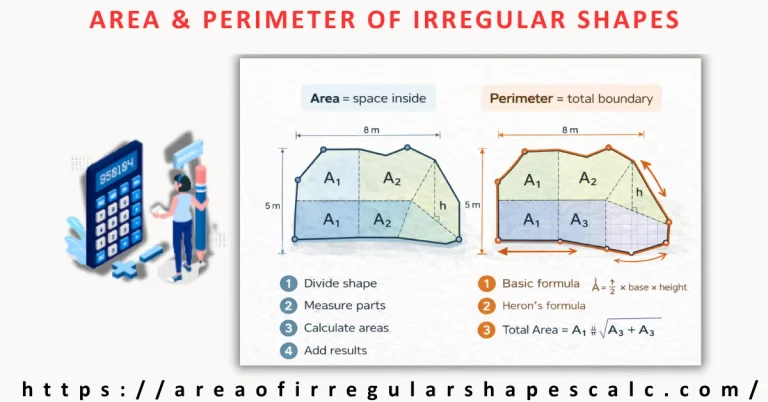
The first step is to observe the shape carefully. Look for natural breakpoints where the shape can be divided into smaller sections.
The second step is to split the shape into familiar geometric forms. These may include rectangles, triangles, or trapezoids depending on the structure of the shape.
The third step is to calculate the area of each individual section using the appropriate formula.
The final step is to add all calculated areas together to obtain the total area of the original shape.
Although these steps seem simple, the accuracy of the result depends heavily on how well the shape is divided in the beginning. A good division simplifies the entire process, while a poor one creates unnecessary complexity.
Smart Strategies to Break Irregular Shapes Effectively
This is where most learners struggle — not in calculation, but in deciding how to divide the shape.
A few practical strategies can make this step much easier.
The first strategy is to look for straight edges. Straight lines often indicate where a rectangle or triangle can be formed easily.
The second is to prefer rectangles whenever possible. Rectangles are the simplest shapes to calculate, so using them reduces effort and chances of error.
The third is to avoid overlapping sections. Each part of the shape should be counted only once. Overlapping leads to incorrect results.
Another useful approach is to identify symmetry. If the shape has repeating or mirrored sections, you can calculate one part and reuse the result.
Finally, break complex shapes step by step instead of trying to divide everything at once. Simplify gradually.
These strategies transform decomposition from a trial-and-error process into a logical and efficient method.
Types of Decomposition Approaches
Not all irregular shapes are divided in the same way. Depending on the structure, different decomposition approaches can be used.
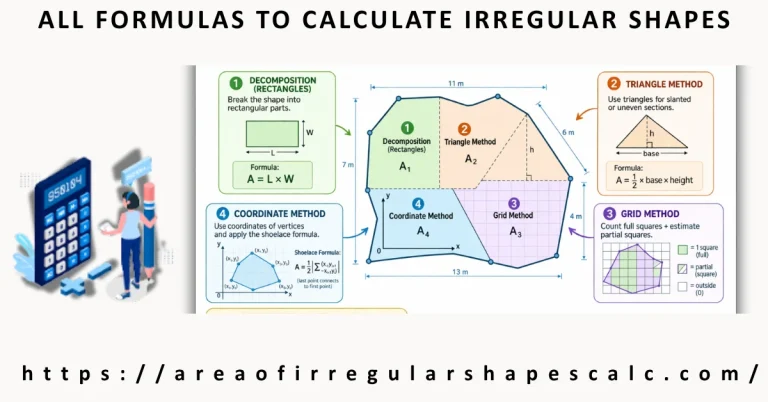
In rectangle-based decomposition, the shape is divided primarily into rectangles. This is the most common approach and works well for floor plans and building layouts.
In triangle-based decomposition, the shape is split into triangles. This is useful when the shape has slanted edges or uneven boundaries.
In mixed decomposition, both rectangles and triangles are used together. This approach provides flexibility and is often required for more complex shapes.
Choosing the right type of decomposition depends on how the shape is formed. With practice, recognizing the best approach becomes intuitive.
Step-by-Step Solved Examples Using Decomposition
Understanding the method conceptually is important, but real clarity comes when you see it applied step by step. Let’s walk through a few practical examples that reflect real situations people often face.
Example 1: L-Shaped Room (Common in Homes)
Imagine a room that looks like an “L”. Instead of trying to measure it as one shape, we divide it into two rectangles.
Step 1: Break the shape into two rectangles. – Rectangle A: 10 m × 6 m – Rectangle B: 4 m × 3 m
Step 2: Calculate each area. – Area A = 10 × 6 = 60 m² – Area B = 4 × 3 = 12 m²
Step 3: Add both areas. Total area = 60 + 12 = 72 m²
This is exactly how most floor plan calculations are done in real life.
Example 2: Irregular Land Plot with a Slanted Side
Now consider a land plot where one side is angled. This shape can be divided into a rectangle and a triangle.
Step 1: Identify components. – Rectangle: 12 m × 8 m – Triangle: base = 5 m, height = 6 m
Step 2: Calculate areas. – Rectangle = 12 × 8 = 96 m² – Triangle = ½ × 5 × 6 = 15 m²
Step 3: Add results. Total area = 96 + 15 = 111 m²
This approach is widely used in land measurement and construction planning.
Example 3: Complex Shape with Three Sections
Sometimes shapes are not just two parts. Let’s consider a shape divided into three components: two rectangles and one triangle.
Step 1: Break into parts. – Rectangle A: 8 × 5 = 40 m² – Rectangle B: 6 × 4 = 24 m² – Triangle: ½ × 4 × 3 = 6 m²
Step 2: Add all areas. Total area = 40 + 24 + 6 = 70 m²
The more complex the shape, the more useful decomposition becomes.
Decomposition vs Other Methods
While decomposition is powerful, it is not the only method available. However, it remains the most practical in most real-world scenarios.
Coordinate-based methods require plotting points and applying formulas like the shoelace formula. These are accurate but require more technical knowledge.
Approximation methods estimate area visually or through grids, but they sacrifice accuracy.
In contrast, decomposition offers a balance between simplicity and precision. It uses basic formulas while maintaining accuracy, which is why it is preferred for everyday applications.
Common Mistakes to Avoid
Even though the method is simple, certain mistakes can lead to incorrect results.
One common mistake is overlapping sections. When dividing shapes, each part must be counted only once.
Another issue is missing small sections. Sometimes small triangular or rectangular portions are ignored, which reduces accuracy.
Incorrect measurements are also a frequent problem. Even a small measurement error can significantly affect the final result.
Finally, choosing a complicated division instead of a simple one can make calculations harder than necessary.
Being careful in the first step — dividing the shape — prevents most of these errors.
Real-Life Applications of Decomposition Method
The decomposition method is not just a classroom concept. It is used in many real-world situations where shapes are rarely perfect.
In construction, it helps estimate flooring, tiling, and material requirements.
In real estate, it is used to calculate property sizes, especially for irregular plots.
In architecture, it assists in designing layouts and optimizing space usage.
Even in everyday scenarios like measuring a backyard or planning furniture placement, decomposition provides a simple and reliable solution.
When Should You Use Decomposition?
You should use decomposition when:
- The shape is irregular or uneven
- You can identify smaller regular shapes within it
- You have direct measurements instead of coordinates
It is especially useful when accuracy is important but advanced mathematical tools are not available.
Frequently Asked Questions (FAQs)
1. How do you find the area of an irregular shape?
You divide the shape into smaller regular shapes, calculate each area, and then add them together.
2. What is the easiest method for irregular shapes?
The decomposition method is considered the easiest because it uses simple and familiar formulas.
3. Can decomposition be used for any shape?
Yes, as long as the shape can be divided into non-overlapping regular sections.
4. Is decomposition accurate?
Yes, it is highly accurate when measurements are correct and divisions are done properly.
5. What shapes are commonly used in decomposition?
Rectangles, triangles, and trapezoids are the most commonly used shapes.
Final Thoughts
The decomposition method transforms a complex problem into a series of simple steps. Instead of struggling with an irregular shape, you break it down, solve each part, and combine the results.
This approach not only simplifies calculations but also builds confidence in handling real-world measurement problems.
Once you start seeing shapes as combinations of smaller parts, solving them becomes natural.