Irregular Trapezoid / Trapezium Area Calculator
Calculate the area of an irregular trapezoid (trapezium) using bases and height, side lengths only (no height), or coordinates.
Bases & Height
Trapezoids look simple until you try to measure one outside a textbook. On paper, the height is clear and the bases line up neatly. In the real world, nothing is that cooperative. The shape is tilted, the surface is sloped, and the “height” you are supposed to use is nowhere to be seen.
If you have ever stood on a roof section, a ramp, or a piece of land and asked yourself where the height actually is, you are not alone. That exact confusion is why incorrect trapezoid areas are so common.
This Irregular Trapezoid / Trapezium Area Calculator is built for those moments. It works with the kind of measurements people actually have, not the ones geometry books assume.
Trapezoid vs Trapezium – Same Shape, Different Name
The naming can be confusing, so it helps to clear this up early.
In the United States, the shape is usually called a trapezoid. In the UK and many other regions, the same shape is called a trapezium. The definition is identical in both cases.
It is a four-sided shape with exactly one pair of parallel sides.
This calculator supports both names because people search for both, and because the geometry does not change just because the terminology does.
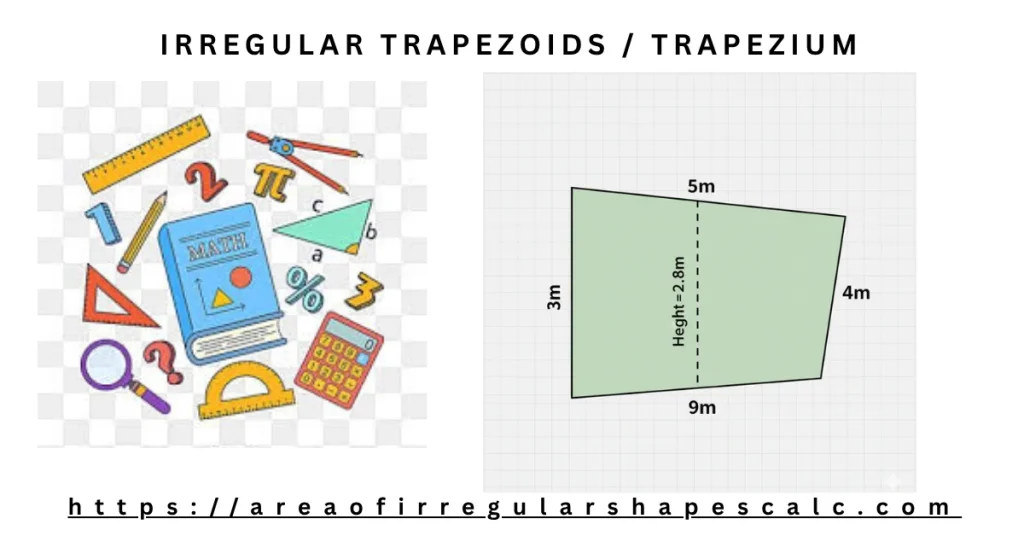
What Makes a Trapezoid Irregular in Real Life
A trapezoid becomes irregular when it stops behaving like the clean diagrams you see in books. In practice, this usually means the non-parallel sides are different lengths, the shape is rotated or skewed, or the height is not clearly measurable.
Most trapezoids found in construction, land measurement, or layouts are irregular by default. They tilt, adapt to constraints, and follow practical needs rather than geometric rules. Treating them as rectangles or guessing a height often leads to quiet but serious errors.
Why Trapezoid Area Often Goes Wrong
The standard trapezoid formula depends entirely on one thing: a true perpendicular height.
In real measurements, that height is often impossible to capture. The base may be slanted, the surface may be uneven, or the only available measurements come from tape lengths, plans, or maps.
When people cannot clearly identify the height, they either guess it or measure something close enough. That is usually where the error enters.
This calculator avoids that problem by offering multiple methods and letting you choose the one that actually matches your data.
Practical Ways to Calculate Irregular Trapezoid Area
Instead of forcing a single formula, the calculator adapts to the situation you are in.
Bases and Height
This is the familiar method and works well when a true perpendicular height is known. It is commonly used when measurements come from drawings, CAD files, or clearly defined plans.
When the height is correct, this method is fast and reliable. When the height is guessed, it is not.
Side Lengths Only
Sometimes measuring height is not possible at all, especially on slopes or angled surfaces. In those cases, side lengths may be the only reliable measurements available.
This method allows area calculation using all four sides, without forcing a perpendicular height. It is especially useful when working directly on site.
Coordinates
For highly skewed shapes or mapped boundaries, coordinates are the safest option. Survey points, map data, or extracted drawing coordinates define the trapezoid exactly as it exists.
When accuracy matters and the shape is irregular, coordinates remove ambiguity entirely.
How to Use This Trapezoid Area Calculator
The workflow is intentionally simple and mirrors how professionals think.
First, choose the calculation method that matches the measurements you have. Then select your input unit, enter the values, and click calculate.
The calculator applies the correct geometry internally and displays the area clearly in square units.
Real-World Situations Where Trapezoids Appear
Irregular trapezoids are not rare shapes. They appear wherever design meets constraint.
Roof sections often form trapezoids because of slope and structural limits. Measuring a clean height on a roof is rarely practical, which makes alternative methods essential.
Land parcels frequently follow roads, rivers, or zoning boundaries. These constraints create trapezoidal plots that are uneven and slanted, where accuracy matters for valuation and planning.
Ramps, drainage channels, and access paths naturally form trapezoidal shapes designed for flow and usability rather than mathematical simplicity.
Interior layouts, extensions, and stair landings often produce trapezoidal spaces when walls meet at angles. Treating these areas as rectangles usually leads to wasted materials.
Common Errors This Calculator Helps Avoid
Many trapezoid errors come from habit rather than misunderstanding. People reuse rectangle formulas, pick the wrong sides as bases, or mix units without noticing.
By forcing you to choose a method that matches your data, this calculator reduces those mistakes before they affect the result.
When This Calculator Is the Right Choice
Use this calculator when your shape has one pair of parallel sides and does not behave like a neat rectangle. If both pairs of sides are parallel, a parallelogram calculator may fit better.
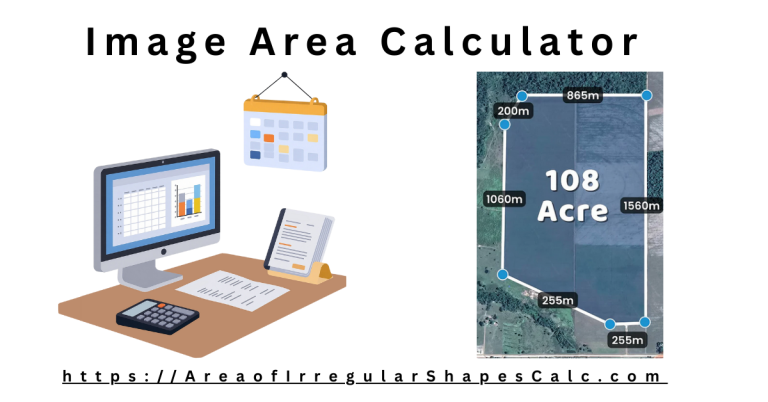
If no sides are parallel, an irregular quadrilateral calculator is more appropriate. For freehand or image-based measurements, the draw or image tools are a better match.
Final Thoughts
Irregular trapezoids exist because real spaces are shaped by constraints, not formulas. Trying to force them into ideal geometry usually creates more confusion than clarity.
This calculator adapts to how measurements are actually taken. By matching the method to the data you have, it helps you reach accurate results with confidence, even when the shape refuses to cooperate.